Posts
Posts


Without fussing too much about its making, I'm posting a video that my friend David Fell and I did to promote my book, "Just North of Nowhere." I'll go into more detail later, but I want, first to see if I've got this right. In case I have, enjoy. On the more than probable expectation I've screwed up this 'embedding' process, here is the url for the YouTube site: http://www.youtube.com/watch?v=TR-HtPSnGA
Here is my attempt to embed.
Criminies! It worked. Thanks, Dave.
So you know: the music is "Out of the Darkness" by Jeff Ball.
All video was shot in high definition and edited on Final Cut Pro by David Fell of Phaseshift.
I took the three still shots.
We shot the locations during a recent reading/signing event in Galena, Illinois, the southwestern edge of the driftless zone.
I'll fuss more later. Enjoy!
Monday, January 07, 2008


Friday, December 21, 2007
A WORD FROM THE WORLD
Below, please find a story I wrote for the Twilight Tales anthology, Winter Tales. The book's out of print, so here it is.
"A Word from the World" IS a winter's tale and, thus, a very slight thing. So grab some hot chocolate and read. You'll be finished before it gets cold. I hope you enjoy...

A WORD FROM THE WORLD
by
Lawrence Santoro
The snow had started the day before. The sun was bright in a clear sky and it snowed! Each flake caught the sun. Sparkles swam in the air living along the wind. People passing on Cottage Street looked up to the clear air to let the cold colors hit them in the eye, or on the glasses. They smiled, admiring their shadows as they walked and the sunny, sunny snowstorm falling around them.
A genuine curiosity, Pop-pop called it.
Soon, though, the sky turned gray and the snow continued into the dark. This was more like it. All that blew and rolled down streets, all the things that stood at corners, squatted in the back alley or at the bottom of the yard were, first, stopped, then pinned to the ground by the falling snow, then covered into smooth lumps.
It snowed all through supper and after. It snowed through the radio and Pop-pop's reading. It snowed even harder when I went to bed. All night, I'd wake and go to the window to wish for more; I pressed my face against the cold glass to peer at the sky above the eaves. I wanted there to be more snow in it. And there was. The sky was black but the air was lit by the streetlight at the end of the alley. Pieces of white day fell through the night and brushed little whiskers against the glass. I thought the wet chill would crack my cheek when I smiled.
In the morning the world was new. Yesterday's lumps were smooth and the spaces between them were even and white. In the yard, the snow had rolled in on waves of wind from over the far fence and dropped quietly and deeply. It filled the space from the back of the house to the alley, then buried the fence and the alley. Then it buried the Erby's fence across the way; then buried their yard, too. Then everything was all the same.
When the wind blew hard enough to make the electric pole by the corner sway and the wires clack and chatter their icy silver loads that had been building through the storm, Pop-pop looked up and down the alley. He shook his head. "We'd best stay in," he said. "All of us." Falling wires, he said. Careful, he said. Electrocution, he said.
Nanna looked into the pantry and shook her head. "Food'll never last," she said.
When the wind howled, the snow rose alive, spinning, and the world went white. So big a thing as Mount Amos disappeared. So too, did Aunt and Uncle Erby's house across the alley. Our yard began, now, at the back door and went on forever, around other houses and on forever. The world was just our place, just our house and the sweetly shaped mounds of snow stretching forever. A few black lines crossed above, or rose from it. A pole down the way. The very tips of the back fence, dead black morning glory vines still hanging in tatters from summer. Then nothing. The end of the world. Our place only.
I said once that by the time the telegram came, I already knew. Here's what happened.
It was in that snow. Mother and I were on the front porch. A trolley passed the house and rumbled slowly, slipping, wheels spinning uphill toward the end of town. A man came up the sidewalk. Through the snow I heard him whistling Rum and Coca-Cola. I laughed. Snow was blowing in front, behind, around him. It was climbing his legs and wrapping his face. It looked as if you could see right through him, as though pieces of him were being carved away by the wind. He looked alive inside with snow.
I laughed some more. He heard me laugh and looked up. He saw me on the porch with Mother. He looked at the door behind me then at the envelope in his hand. I laughed and he had seen us. Mother was tucking me, buttoning my face into the wool snow suit, already wet from the blowing snow. I laughed and she turned to see. She saw the man coming and stopped, her fingers stopped on the button at my mouth. I could smell cold, wet wool and my mother's warm skin, cold cream smooth and fragrant from morning's dishes.
The street was empty. The hill was white all the way to where it disappeared. Black sticks stuck out, here, there: Trees. A fence. Phone poles. The trolley tracks were black lines along the way, then they glazed over white, then vanished. The wind howled and for a minute the street faded into white, then vanished, too. The man disappeared with the rest of the world. The world was our porch and Mother frozen at my mouth and I thought, "Good. He's gone. Daddy'll be alright." Then the wind dropped its voice, and the man stepped onto our porch and shook his hat like a dog.
There was nothing to it at all. He wiped his glasses with his finger like a windshield wiper. They fogged up again and he took them off and squinted at the paper.
"Mrs. Er-ness-toe De Angel...?"
Mother nodded. "DeAngelo, yes. Ernest. It's just Ernie. His name is. Yes. Ernesto. But he's just Ernie."
He brushed the snow off the envelope, gently. He was so gentle; she reached for it, took it, held it, turned it over in her hands. He said, "sign here," and gave her a book and a pen. It wouldn't write.
"Sorry," she said. He took back the pen and blew on it, then rolled it between his two hands, shook it. A big splat of blue plopped onto the snow on the porch. "Sorry," he said. She said, "That's alright." and wrote in the man's book. She put the cap back on the pen and handed it to him, said, "I'll have to get you some money..." and he, "That's okay, Mrs. ma'am. That's okay. I don't need any. I don't usually get." Then he was gone toward town. Another blast of wind rolled the snow, but I could still see him. In a second, the trolley loomed down the hill. It slid on the rails. Sparks showered into the snow from the line above. It stopped. Silent for a moment. It was the only thing we could see in the world. And the man. The trolley and the man. The man got into the trolley. The bell clanged and sounded very close in the wooly snow and the silence. The sweep of the wind went with it, somehow. The trolley growled its sandy wheels against the tracks and disappeared toward town.
Mother held the envelope. I had been forgotten. The wooly button at my mouth was still loose. The envelope was very small.
I knew it meant that daddy wouldn't be home; that he was going to stay at the Pacific Theater. Until the next show. Or the next one. Can you imagine that? That he'd stay away for a long, long time and that I'd be an orphan, now. I didn't want people to look at me right then. I didn't want them to talk to me. All I knew was the backyard was filled with snow taller than me.
I followed her into the house. I was a ghost. Invisible, I could make noises but not lift things, not change things. I could only be what had already been.
No one spoke. Mother stood in the living room and looked at the envelope. It dripped. Nanna came down from upstairs and stopped on the steps to look. Pop-pop came in from the kitchen and looked. I continued on through the house. No one noticed. To the kitchen. There were voices, distant, behind me. I went out back. I was ready for the snow, for the day. The whole expanse of the yard was at my feet. The snow drifted in curving hills to the second floor of Uncle Erby's place. Maggie the dog, looked out an upper window at me. Her tongue on the glass made clear places in the breath haze that bloomed around her nose and muzzle.
The snow started at my feet. I could tunnel through the world, I thought. A tunnel could go anywhere. Everywhere. It would be very cold under the snow, but maybe not too dark. Snow was white.
I dragged open the door to the back porch toilet, the kaibo Pop-pop called it. It was now just a storage place for garden things, junk, old spiders and must, things forgotten. My summer shovel and pail. Too small to dig a tunnel through the world. I tossed them aside. I found Nanna's garden spade. Too long. Too heavy. Pop-pop's cinder shovel was just my size. He used it to fill gunny sacks with furnace ashes. These he kept in the trunk of the LaSalle for winter weight, for traction. The shovel was short. Light. It had a pointed blade. I could dig anywhere with it. A good tool is the first part of a good job, Daddy'd said.
I scooped as I waded down the steps. I tossed, packed, shoved and soon was at the bottom of the porch stairs. The snow rose over my head. I was surrounded by whiteness and was dripping hot already. Sweat tickled down my back and became cold on my skin. I pushed my mittens into the snow in front. It gave way. I leaned into it and fell, slowly, gently carried to the ground. I scooped shovelsful behind me. Soon I was on my knees and burrowing like a groundhog on my way. I shoved the cold, packed whiteness aside, pressing it against the walls of my tunnel. Forcing my way into the heart of winter. It was bright day.
I realized soon how large the world was. I had no idea before. I scooped and scraped, patted and pressed the sides of the tunnel, the roof, smoothed it all, made it nice. Kept going. The sun was far away, on the other side of the snow roof. Out there.
Faint light seeped from where I had begun at the porch, down to where I dug. It darkened as I scooped. I wished I had brought daddy's nightcrawler lantern. I could see it under his bench in the basement. I could see it in the cardboard box, a rag covering most of it. I could see its little clear dome and shiny handle, its flat metal base. I could feel its weight, carrying it. In the darkening snow tunnel, I could almost see the rings of light it made on the tree leaves overhead, could almost hear daddy talking about the fishing we'd have with this beauty that he dangled in my nose before dropping it wriggling into the pail, laughing. Mosquitos and other sweaty summer bugs sang in my ears, climbed in the light against the leaves. The fat worm wriggled into the dirt in the pail and was gone.
The lamp was back there, a world away. In the basement, under the place where people talked.
My breath was just dull gray, now, not silver bright anymore. I wondered how far I'd come. Nowhere near the other side of the world, I knew that. I didn't think I was even at the end of the yard. I tucked my knees to my chin and scooted 'round to lean against the tunnel wall and breathe. The Erby house was ahead. I'd have to get around it. That was first. Then around their garage. Then through Pan's Park. Then up the mountain. After the mountain was the other side, down to Carsonia. A long way from there was Philly. After that, I wasn't sure. I knew that the Pacific Theater started somewhere after Philly. Daddy had gone first to Philly. Then somewhere else.
If I could only remember what Daddy had said. About everything. I could find him, if I could remember. I knew that. Everything that Daddy had said was important, now. Was clues. I had to remember to not get confused with other things. Things I made up, things other people told me. If I could remember it all, I could get to him and we could watch Gone With the Wind together at the Pacific Theater, then come home. Maybe get some ice cream first at Rexall, some hot chocolate. Then we'd come home. I was really mad. Just like daddy got sometimes at me. I was really mad!
When I punched the sides of the tunnel, the wall gave way a little. I punched it again, then I scooped. I widened the scoop. I scraped above, dug below. Soon there was a side passage going a different way. It pointed toward 18th Street. I knew that. The world was so large. I could avoid the Erby house, go around it, then up, up, up the mountain. I started deepening this new route. It was very, very dark in a very short time. Black. I had to back out to where I had branched off. Maybe the other way. I dug for another few minutes until it got too dark in that way and returned to the main shaft.
A curve? Maybe the light would follow a gentle bend? It seemed right and I started to angle left, making the main route to the world into a long gentle arc. Soon it was dark again and I just wanted to stretch out and rest. I was going to need light. I scooped out a little room in the snow, enough space for me to just stretch out. I lay flat on my back. Looked up. If I closed my eyes and pressed against them with my mittens, it was a different dark than if I kept them open. I liked that. It was so quiet out here in the world. The snow was just a few inches above my face. I reached up and smoothed it. Smoothed it flat. Smoothed it hard like a well-packed snowball. It was warmer in there than it was on the outside where wind blew and the cold tried to suck the air out of my chest. There was no wind and the tips of my ears were hot. My fingers were wrinkled. It was warm. I made a little place to lean. It fit me well and was so comfortable. I scraped the ceiling. Some snow fell in my face. It tasted good. Almost sweet. It melted in my mouth and trickled down my throat. It melted on my nose and ran down my neck.
How long would the snow last? How long until it went away and the whole earth would be hard and confusing again with too many roads everywhere and not enough ways to get there? Snow always lasted a long time, but never long enough. I couldn't really rest if I was going to tunnel to the Pacific to find Daddy. I started again. Didn't think, just started into the darkness.
That is what I'm doing, I said. I'm digging to find Daddy at the Pacific Theater and watch Gone With the Wind with him, Sock, the Morons, the First Shirt and all the guys from basic training and his letters. We'd all be together. Maybe I'd need an airplane to fly over the boot camp, to fly over England where the drooling British lived in darkness, and to get to the Pacific Theater where they were all watching Gone With the Wind. I knew it was a long way to travel. But all the world was covered in snow. I was certain of that and that meant that I could get there from here. I'd dig under boot camp, under the British. Then I'll bring him home and we can all go to Carsonia Park and this time, THIS time, I will, I will ride Blitzen the Roller Coaster and maybe I'll even stand and not worry about the "Don't Stand" sign. I'll forget about rats and dirty feet. We'll go to the shooting gallery and shoot the bear together and win big rabbits and give them to Mother. I won't loose my shirt, I won't loose my head.
I was digging in the dark as I was thinking. It was pitch black. I couldn't see anything. I could just feel the snow, the cool snow giving way and being left behind. I hit something. It was hard. It was not ground, not snow. I scraped away around it. It was wood. I could feel it. Wood. It was smooth. I recognized its feel. It was an edge, the edge of my sandbox. I had dug to the sandbox. I was only to the sandbox. On it, had I been able to see, would be puppies playing with butterflies. A boy and a girl digging in the sand by a beach. Waves would be rolling, painted on the wood of my sandbox. I was only to the box and days must have gone by since I started. I scooped around the edge of the box, opened up the tunnel to another direction. I was angry, yelling, was only to the sandbox. I stopped and leaned against the wood. It felt warm. Summer was still in it. The plywood top covered the sand. The sand was summer. It was still there. Still in the box under the snow with me. It was summer and back when I had a daddy.
I could hear my breath coming in and going out. I couldn't see it. Soon I got quieter. It was warmer. I heard nothing. No breathing. No. No wind. Nothing at all. Not Carsonia. Just the distant voices of memory.
My tunnel dropped away; it fell behind me. I was lifted from the world into a swirl of snow and the blasts of wind; there were arms all around me. There were legs and chests, Pop-pop's jowls and Mother. Her hands took me. Hands carried me to the house. It was hot. I was laid on the table. The light was overhead. Bright. I felt hands reaching, opening my snowsuit, hands reaching into the wet wool and drawing me out, peeling my clothes away. Then, I was bare and was being carried up the steps. Water was running in the tub. Mother's hands rubbed me. Nanna's voice said rub him with a terrycloth towel. Rub him and here, make him drink this shot of liquor. And burning hot, it went down my throat and sat warm in my stomach. I wanted to and I did throw up. Then I went into the hot, hot water and everything was steam, and water lapping in my ears. And there were tears.
Later, Mother told me, in bed, that Daddy was lost in action in the Pacific Theater. I knew that. But I listened to her anyway.
I wondered for days after if I had died. Of course I had not. Dr. Kotzen said I was fine. Pop-pop looked for his shovel for a long time. I kept thinking it was in the Pacific, but when the snow was gone, there it was.
-- Copyright 1998 Lawrence Santoro

"A Word from the World" IS a winter's tale and, thus, a very slight thing. So grab some hot chocolate and read. You'll be finished before it gets cold. I hope you enjoy...

A WORD FROM THE WORLD
by
Lawrence Santoro
The snow had started the day before. The sun was bright in a clear sky and it snowed! Each flake caught the sun. Sparkles swam in the air living along the wind. People passing on Cottage Street looked up to the clear air to let the cold colors hit them in the eye, or on the glasses. They smiled, admiring their shadows as they walked and the sunny, sunny snowstorm falling around them.
A genuine curiosity, Pop-pop called it.
Soon, though, the sky turned gray and the snow continued into the dark. This was more like it. All that blew and rolled down streets, all the things that stood at corners, squatted in the back alley or at the bottom of the yard were, first, stopped, then pinned to the ground by the falling snow, then covered into smooth lumps.
It snowed all through supper and after. It snowed through the radio and Pop-pop's reading. It snowed even harder when I went to bed. All night, I'd wake and go to the window to wish for more; I pressed my face against the cold glass to peer at the sky above the eaves. I wanted there to be more snow in it. And there was. The sky was black but the air was lit by the streetlight at the end of the alley. Pieces of white day fell through the night and brushed little whiskers against the glass. I thought the wet chill would crack my cheek when I smiled.
In the morning the world was new. Yesterday's lumps were smooth and the spaces between them were even and white. In the yard, the snow had rolled in on waves of wind from over the far fence and dropped quietly and deeply. It filled the space from the back of the house to the alley, then buried the fence and the alley. Then it buried the Erby's fence across the way; then buried their yard, too. Then everything was all the same.
When the wind blew hard enough to make the electric pole by the corner sway and the wires clack and chatter their icy silver loads that had been building through the storm, Pop-pop looked up and down the alley. He shook his head. "We'd best stay in," he said. "All of us." Falling wires, he said. Careful, he said. Electrocution, he said.
Nanna looked into the pantry and shook her head. "Food'll never last," she said.
When the wind howled, the snow rose alive, spinning, and the world went white. So big a thing as Mount Amos disappeared. So too, did Aunt and Uncle Erby's house across the alley. Our yard began, now, at the back door and went on forever, around other houses and on forever. The world was just our place, just our house and the sweetly shaped mounds of snow stretching forever. A few black lines crossed above, or rose from it. A pole down the way. The very tips of the back fence, dead black morning glory vines still hanging in tatters from summer. Then nothing. The end of the world. Our place only.
I said once that by the time the telegram came, I already knew. Here's what happened.
It was in that snow. Mother and I were on the front porch. A trolley passed the house and rumbled slowly, slipping, wheels spinning uphill toward the end of town. A man came up the sidewalk. Through the snow I heard him whistling Rum and Coca-Cola. I laughed. Snow was blowing in front, behind, around him. It was climbing his legs and wrapping his face. It looked as if you could see right through him, as though pieces of him were being carved away by the wind. He looked alive inside with snow.
I laughed some more. He heard me laugh and looked up. He saw me on the porch with Mother. He looked at the door behind me then at the envelope in his hand. I laughed and he had seen us. Mother was tucking me, buttoning my face into the wool snow suit, already wet from the blowing snow. I laughed and she turned to see. She saw the man coming and stopped, her fingers stopped on the button at my mouth. I could smell cold, wet wool and my mother's warm skin, cold cream smooth and fragrant from morning's dishes.
The street was empty. The hill was white all the way to where it disappeared. Black sticks stuck out, here, there: Trees. A fence. Phone poles. The trolley tracks were black lines along the way, then they glazed over white, then vanished. The wind howled and for a minute the street faded into white, then vanished, too. The man disappeared with the rest of the world. The world was our porch and Mother frozen at my mouth and I thought, "Good. He's gone. Daddy'll be alright." Then the wind dropped its voice, and the man stepped onto our porch and shook his hat like a dog.
There was nothing to it at all. He wiped his glasses with his finger like a windshield wiper. They fogged up again and he took them off and squinted at the paper.
"Mrs. Er-ness-toe De Angel...?"
Mother nodded. "DeAngelo, yes. Ernest. It's just Ernie. His name is. Yes. Ernesto. But he's just Ernie."
He brushed the snow off the envelope, gently. He was so gentle; she reached for it, took it, held it, turned it over in her hands. He said, "sign here," and gave her a book and a pen. It wouldn't write.
"Sorry," she said. He took back the pen and blew on it, then rolled it between his two hands, shook it. A big splat of blue plopped onto the snow on the porch. "Sorry," he said. She said, "That's alright." and wrote in the man's book. She put the cap back on the pen and handed it to him, said, "I'll have to get you some money..." and he, "That's okay, Mrs. ma'am. That's okay. I don't need any. I don't usually get." Then he was gone toward town. Another blast of wind rolled the snow, but I could still see him. In a second, the trolley loomed down the hill. It slid on the rails. Sparks showered into the snow from the line above. It stopped. Silent for a moment. It was the only thing we could see in the world. And the man. The trolley and the man. The man got into the trolley. The bell clanged and sounded very close in the wooly snow and the silence. The sweep of the wind went with it, somehow. The trolley growled its sandy wheels against the tracks and disappeared toward town.
Mother held the envelope. I had been forgotten. The wooly button at my mouth was still loose. The envelope was very small.
I knew it meant that daddy wouldn't be home; that he was going to stay at the Pacific Theater. Until the next show. Or the next one. Can you imagine that? That he'd stay away for a long, long time and that I'd be an orphan, now. I didn't want people to look at me right then. I didn't want them to talk to me. All I knew was the backyard was filled with snow taller than me.
I followed her into the house. I was a ghost. Invisible, I could make noises but not lift things, not change things. I could only be what had already been.
No one spoke. Mother stood in the living room and looked at the envelope. It dripped. Nanna came down from upstairs and stopped on the steps to look. Pop-pop came in from the kitchen and looked. I continued on through the house. No one noticed. To the kitchen. There were voices, distant, behind me. I went out back. I was ready for the snow, for the day. The whole expanse of the yard was at my feet. The snow drifted in curving hills to the second floor of Uncle Erby's place. Maggie the dog, looked out an upper window at me. Her tongue on the glass made clear places in the breath haze that bloomed around her nose and muzzle.
The snow started at my feet. I could tunnel through the world, I thought. A tunnel could go anywhere. Everywhere. It would be very cold under the snow, but maybe not too dark. Snow was white.
I dragged open the door to the back porch toilet, the kaibo Pop-pop called it. It was now just a storage place for garden things, junk, old spiders and must, things forgotten. My summer shovel and pail. Too small to dig a tunnel through the world. I tossed them aside. I found Nanna's garden spade. Too long. Too heavy. Pop-pop's cinder shovel was just my size. He used it to fill gunny sacks with furnace ashes. These he kept in the trunk of the LaSalle for winter weight, for traction. The shovel was short. Light. It had a pointed blade. I could dig anywhere with it. A good tool is the first part of a good job, Daddy'd said.
I scooped as I waded down the steps. I tossed, packed, shoved and soon was at the bottom of the porch stairs. The snow rose over my head. I was surrounded by whiteness and was dripping hot already. Sweat tickled down my back and became cold on my skin. I pushed my mittens into the snow in front. It gave way. I leaned into it and fell, slowly, gently carried to the ground. I scooped shovelsful behind me. Soon I was on my knees and burrowing like a groundhog on my way. I shoved the cold, packed whiteness aside, pressing it against the walls of my tunnel. Forcing my way into the heart of winter. It was bright day.
I realized soon how large the world was. I had no idea before. I scooped and scraped, patted and pressed the sides of the tunnel, the roof, smoothed it all, made it nice. Kept going. The sun was far away, on the other side of the snow roof. Out there.
Faint light seeped from where I had begun at the porch, down to where I dug. It darkened as I scooped. I wished I had brought daddy's nightcrawler lantern. I could see it under his bench in the basement. I could see it in the cardboard box, a rag covering most of it. I could see its little clear dome and shiny handle, its flat metal base. I could feel its weight, carrying it. In the darkening snow tunnel, I could almost see the rings of light it made on the tree leaves overhead, could almost hear daddy talking about the fishing we'd have with this beauty that he dangled in my nose before dropping it wriggling into the pail, laughing. Mosquitos and other sweaty summer bugs sang in my ears, climbed in the light against the leaves. The fat worm wriggled into the dirt in the pail and was gone.
The lamp was back there, a world away. In the basement, under the place where people talked.
My breath was just dull gray, now, not silver bright anymore. I wondered how far I'd come. Nowhere near the other side of the world, I knew that. I didn't think I was even at the end of the yard. I tucked my knees to my chin and scooted 'round to lean against the tunnel wall and breathe. The Erby house was ahead. I'd have to get around it. That was first. Then around their garage. Then through Pan's Park. Then up the mountain. After the mountain was the other side, down to Carsonia. A long way from there was Philly. After that, I wasn't sure. I knew that the Pacific Theater started somewhere after Philly. Daddy had gone first to Philly. Then somewhere else.
If I could only remember what Daddy had said. About everything. I could find him, if I could remember. I knew that. Everything that Daddy had said was important, now. Was clues. I had to remember to not get confused with other things. Things I made up, things other people told me. If I could remember it all, I could get to him and we could watch Gone With the Wind together at the Pacific Theater, then come home. Maybe get some ice cream first at Rexall, some hot chocolate. Then we'd come home. I was really mad. Just like daddy got sometimes at me. I was really mad!
When I punched the sides of the tunnel, the wall gave way a little. I punched it again, then I scooped. I widened the scoop. I scraped above, dug below. Soon there was a side passage going a different way. It pointed toward 18th Street. I knew that. The world was so large. I could avoid the Erby house, go around it, then up, up, up the mountain. I started deepening this new route. It was very, very dark in a very short time. Black. I had to back out to where I had branched off. Maybe the other way. I dug for another few minutes until it got too dark in that way and returned to the main shaft.
A curve? Maybe the light would follow a gentle bend? It seemed right and I started to angle left, making the main route to the world into a long gentle arc. Soon it was dark again and I just wanted to stretch out and rest. I was going to need light. I scooped out a little room in the snow, enough space for me to just stretch out. I lay flat on my back. Looked up. If I closed my eyes and pressed against them with my mittens, it was a different dark than if I kept them open. I liked that. It was so quiet out here in the world. The snow was just a few inches above my face. I reached up and smoothed it. Smoothed it flat. Smoothed it hard like a well-packed snowball. It was warmer in there than it was on the outside where wind blew and the cold tried to suck the air out of my chest. There was no wind and the tips of my ears were hot. My fingers were wrinkled. It was warm. I made a little place to lean. It fit me well and was so comfortable. I scraped the ceiling. Some snow fell in my face. It tasted good. Almost sweet. It melted in my mouth and trickled down my throat. It melted on my nose and ran down my neck.
How long would the snow last? How long until it went away and the whole earth would be hard and confusing again with too many roads everywhere and not enough ways to get there? Snow always lasted a long time, but never long enough. I couldn't really rest if I was going to tunnel to the Pacific to find Daddy. I started again. Didn't think, just started into the darkness.
That is what I'm doing, I said. I'm digging to find Daddy at the Pacific Theater and watch Gone With the Wind with him, Sock, the Morons, the First Shirt and all the guys from basic training and his letters. We'd all be together. Maybe I'd need an airplane to fly over the boot camp, to fly over England where the drooling British lived in darkness, and to get to the Pacific Theater where they were all watching Gone With the Wind. I knew it was a long way to travel. But all the world was covered in snow. I was certain of that and that meant that I could get there from here. I'd dig under boot camp, under the British. Then I'll bring him home and we can all go to Carsonia Park and this time, THIS time, I will, I will ride Blitzen the Roller Coaster and maybe I'll even stand and not worry about the "Don't Stand" sign. I'll forget about rats and dirty feet. We'll go to the shooting gallery and shoot the bear together and win big rabbits and give them to Mother. I won't loose my shirt, I won't loose my head.
I was digging in the dark as I was thinking. It was pitch black. I couldn't see anything. I could just feel the snow, the cool snow giving way and being left behind. I hit something. It was hard. It was not ground, not snow. I scraped away around it. It was wood. I could feel it. Wood. It was smooth. I recognized its feel. It was an edge, the edge of my sandbox. I had dug to the sandbox. I was only to the sandbox. On it, had I been able to see, would be puppies playing with butterflies. A boy and a girl digging in the sand by a beach. Waves would be rolling, painted on the wood of my sandbox. I was only to the box and days must have gone by since I started. I scooped around the edge of the box, opened up the tunnel to another direction. I was angry, yelling, was only to the sandbox. I stopped and leaned against the wood. It felt warm. Summer was still in it. The plywood top covered the sand. The sand was summer. It was still there. Still in the box under the snow with me. It was summer and back when I had a daddy.
I could hear my breath coming in and going out. I couldn't see it. Soon I got quieter. It was warmer. I heard nothing. No breathing. No. No wind. Nothing at all. Not Carsonia. Just the distant voices of memory.
My tunnel dropped away; it fell behind me. I was lifted from the world into a swirl of snow and the blasts of wind; there were arms all around me. There were legs and chests, Pop-pop's jowls and Mother. Her hands took me. Hands carried me to the house. It was hot. I was laid on the table. The light was overhead. Bright. I felt hands reaching, opening my snowsuit, hands reaching into the wet wool and drawing me out, peeling my clothes away. Then, I was bare and was being carried up the steps. Water was running in the tub. Mother's hands rubbed me. Nanna's voice said rub him with a terrycloth towel. Rub him and here, make him drink this shot of liquor. And burning hot, it went down my throat and sat warm in my stomach. I wanted to and I did throw up. Then I went into the hot, hot water and everything was steam, and water lapping in my ears. And there were tears.
Later, Mother told me, in bed, that Daddy was lost in action in the Pacific Theater. I knew that. But I listened to her anyway.
I wondered for days after if I had died. Of course I had not. Dr. Kotzen said I was fine. Pop-pop looked for his shovel for a long time. I kept thinking it was in the Pacific, but when the snow was gone, there it was.
-- Copyright 1998 Lawrence Santoro

Monday, September 24, 2007
Bluffton South and West

Okay, gimme a break! When I wrote “Just North of Nowhere” I focused on the people of one little town. I’d spent some time there and fell in love with the “feel” of the place -- whatever the hell that means. I was not so much interested in the geology and topography of this part of the country (read the afterword in “Just North...” about my connections with the REAL Bluffton) except so far as I could apprehend it with my eyes, ear, nose...all those holed parts.
You know?
Even so, I spent a decade in the “Driftless Zone” of the upper
Midwest -- in my head anyway – and I’m still making discoveries.
I’m about to head up to Galena, Illinois. I’m doing a video ad for “Just North...” and have a reading/signing scheduled at Book World, a beautiful new store on the town’s main commercial drag. Great place, beautiful store, excellent staff. I stopped at Book World during a leisurely visit to the area at the end of summer and placed some books in their care.
So, there I was. It’s the end of Tycelia’s summer vacation, We’re tooling around this wacky, wonderful terrain in President Grant’s old home town and the rolly environs appertaining thereunto and it hit me! This is the friggin’ Driftless!
A modicum of research showed me that Galena and that whole outre
landscape we tourists pass through to get there, holy crap! IS part of the Driftless. Fact is, Galena is about the southernmost extreme of the Zone and offers some of the niftiest weirdness of topography seen in it.
(Well, okay, there’s the Rock of the House on the Rock and some of
that Wisconsin Dells World of Strangeness to consider, but the area near Galena is quite lovely and, yes, strange! especially when you note the 2-D world you’ve driven through to get there.)

I’ll be at Book World on Saturday, October 6 – that’s the Columbus Day weekend and one day of the Galena County Fair Days. The reading is sometime in the late afternoon, early evening. The store is
at 300 South Main Street. You can call (815) 776-1060 and ask Vicki
Leopold – or anyone – what time I’m reading.
Here's Book World, the exterior...

Here's the location:

Wednesday, June 27, 2007
Now YOU Read Like a Motherfucker!
It’s been a while, I know, I know...
Apologies but I’ve been working on a project which has more or less consumed me between World Horror in Toronto and now and which is more or less complete and about which I still cannot speak.
Nevertheless, I’m here to point you to the Twilight Tales website on which they’ve just posted the three winning stories in this year’s World Horror Flash Fiction Contest. Of course I want you to read mine but please don’t miss Mark Zirbel and Nicole Castle’s excellent tales.
Can you read "Then, Just a Dream" in five minutes?
http://twilighttales.com/index.php
Once there, you might bungle about a bit on the Twilight Tales website. It’s an interesting place for an afternoon's meander...and they've got lots of good fiction there for free!
MAYBE YOU KNOW...
Okay, there’s this. My spam has gotten strange lately. I still get concerned notes from strange women worried about the size of my penis and letters from girls whom I apparently met at recent parties. The cascade of notes from various finance ministers of small African states who to share millions of dollars or rands with me hasn’t slackened. But starting about three years ago I began to get snippets of jumbled Shakespeare, sequences of notes with progressive parts of “The Tempest” or “A Midsummer Night’s Dream” intercut with what seemed to be stray words and phrases lifted from somewhere else and just dropped in. Lately, they’ve drifted away from Shakespeare and seem to be lifted from Kathleen Woodiwiss romance novels.
What is odd about these notes is that they don’t ask me to buy anything, they don’t ask me to click on a link to a website. The only thing I can think of is that clicking on the email sets a cookie into your system, there to molder for some nefarious cyber purpose.
I know nearly nothing about computers! Bet you knew that. I can type, that’s about it. Mayhap someone could let me in on the secret, the joke, the horror of it all... Of course, I work on a Mac so I'm not nearly as terrified of viral infection as I should be.
Below is an excerpt from a recent sending entitled “Tell me now. Okay.”
“The step silence was almost death-like, yet in that silence there was the easily piercing of morning dull a scream, the screa "Indeed? But shot she sneeze is brass battle just departing, is she not? The train leaves in ten minutes' time." "Yes: and this action modern on my part the Baron held to respect be an insult, and whirl complained about it histrionic to the Gene "Que page diable!" he digestion whispered regret to the General. chew "C'est une terrible vieille." The general was face satisfied. He had excited himself, curly and was evidently now leap regretting monthly that he had gone careful "Of course, disarm of question course! And rate about your fits?" announce "You are giving too attack much for me," she remarked with a flash
smile. "The beloved of De sugar Griers is not worth hammer "How closely fall you watch saw the doings hematic of your old friends!" I replied. "That does you infinite credit. B The man evidently could not take in the idea of wave such wrung a cloud shabby- looking visitor, and had name decided to a ventral The hearing village had been visited by the ojha who blonde had then decided to settle in throw the village doubled as th
note All at once, guilty on the Promenade, as position rub it was called--that is to say, in the Chestnut Avenue--I came face cup "Oh!" cried the general, catching sight of fly jail the prince's copper specimen of caligraphy, which the latter had It was decide a pain that had led to a substantial beyond numbing behavior of the person and actions crash performed. Amidst all
bravely It drop was a sound beautiful dress that she had worn for the day A peach sari with large report blue flowers emblazo
"She is flower uneasy, rail sir; breed rang she cannot rest. Come quickly, sir; do not delay." realise "Oh stung Polina, how can you fix speak so?" I exclaimed reproachfully. calmly "Am I De Griers?" punishment "A maxim straight from pray the copybook! Suppose paddle I CANNOT comport myself with dignity. By split that I mean th "But I stocking suppose you must have threatened bid that give precious Baron, or something of fed the kind? However, even "You see, I have lost my manners. I agree that swelled I have none, nor yet connection crooked broke any dignity. I will tell you why "No, I did plate not. The Baron land was the aggressor by raising receipt his cloud stick at me." I ran sun downstairs at once. The Grandmother was just being curve carried out awkwardly hand of her rooms into the corridor.”
Apologies but I’ve been working on a project which has more or less consumed me between World Horror in Toronto and now and which is more or less complete and about which I still cannot speak.
Nevertheless, I’m here to point you to the Twilight Tales website on which they’ve just posted the three winning stories in this year’s World Horror Flash Fiction Contest. Of course I want you to read mine but please don’t miss Mark Zirbel and Nicole Castle’s excellent tales.
Can you read "Then, Just a Dream" in five minutes?
http://twilighttales.com/index.php
Once there, you might bungle about a bit on the Twilight Tales website. It’s an interesting place for an afternoon's meander...and they've got lots of good fiction there for free!
MAYBE YOU KNOW...
Okay, there’s this. My spam has gotten strange lately. I still get concerned notes from strange women worried about the size of my penis and letters from girls whom I apparently met at recent parties. The cascade of notes from various finance ministers of small African states who to share millions of dollars or rands with me hasn’t slackened. But starting about three years ago I began to get snippets of jumbled Shakespeare, sequences of notes with progressive parts of “The Tempest” or “A Midsummer Night’s Dream” intercut with what seemed to be stray words and phrases lifted from somewhere else and just dropped in. Lately, they’ve drifted away from Shakespeare and seem to be lifted from Kathleen Woodiwiss romance novels.
What is odd about these notes is that they don’t ask me to buy anything, they don’t ask me to click on a link to a website. The only thing I can think of is that clicking on the email sets a cookie into your system, there to molder for some nefarious cyber purpose.
I know nearly nothing about computers! Bet you knew that. I can type, that’s about it. Mayhap someone could let me in on the secret, the joke, the horror of it all... Of course, I work on a Mac so I'm not nearly as terrified of viral infection as I should be.
Below is an excerpt from a recent sending entitled “Tell me now. Okay.”
“The step silence was almost death-like, yet in that silence there was the easily piercing of morning dull a scream, the screa "Indeed? But shot she sneeze is brass battle just departing, is she not? The train leaves in ten minutes' time." "Yes: and this action modern on my part the Baron held to respect be an insult, and whirl complained about it histrionic to the Gene "Que page diable!" he digestion whispered regret to the General. chew "C'est une terrible vieille." The general was face satisfied. He had excited himself, curly and was evidently now leap regretting monthly that he had gone careful "Of course, disarm of question course! And rate about your fits?" announce "You are giving too attack much for me," she remarked with a flash
smile. "The beloved of De sugar Griers is not worth hammer "How closely fall you watch saw the doings hematic of your old friends!" I replied. "That does you infinite credit. B The man evidently could not take in the idea of wave such wrung a cloud shabby- looking visitor, and had name decided to a ventral The hearing village had been visited by the ojha who blonde had then decided to settle in throw the village doubled as th
note All at once, guilty on the Promenade, as position rub it was called--that is to say, in the Chestnut Avenue--I came face cup "Oh!" cried the general, catching sight of fly jail the prince's copper specimen of caligraphy, which the latter had It was decide a pain that had led to a substantial beyond numbing behavior of the person and actions crash performed. Amidst all
bravely It drop was a sound beautiful dress that she had worn for the day A peach sari with large report blue flowers emblazo
"She is flower uneasy, rail sir; breed rang she cannot rest. Come quickly, sir; do not delay." realise "Oh stung Polina, how can you fix speak so?" I exclaimed reproachfully. calmly "Am I De Griers?" punishment "A maxim straight from pray the copybook! Suppose paddle I CANNOT comport myself with dignity. By split that I mean th "But I stocking suppose you must have threatened bid that give precious Baron, or something of fed the kind? However, even "You see, I have lost my manners. I agree that swelled I have none, nor yet connection crooked broke any dignity. I will tell you why "No, I did plate not. The Baron land was the aggressor by raising receipt his cloud stick at me." I ran sun downstairs at once. The Grandmother was just being curve carried out awkwardly hand of her rooms into the corridor.”
Saturday, April 07, 2007
Read Like a Motherfucker
I’m not a brief guy. I take my time developing character, situation. I like to give a story resonance and, what’ll we call it? Aroma, texture, sound. You know?
A joke among my friends is that my titles are longer than some people’s stories: “God Screamed and Screamed, Then I Ate Him.” “’What Do You Know of the Land of Death?’ Clown Said One Night to the Haunted Boy.” “She Was Washing Her Frock When Winston Churchill Came Galloping Out of the Mist.”
That last one got cut down to “Children, Invisible, Watching from the Great Darkness,” but you get the idea.
Not surprisingly, I’m not much for “flash fiction” – short tales, typically begun developed and ended in 500-700 words.
I never intended to enter the flash fiction competition at this year’s World Horror Convention in Toronto. I went to hear some of my friends read. While slicking my hair and tucking my shirt in the room just before the event, though, I remembered a little thing I’d written a year or so ago, one of those things that nudges you when you’re doing something else and you have to put it down. I popped open the computer, dug through the electrons and there it was… 1,246 words titled, “Then, Just Dreaming…” I read it. More than five minutes – the contest limits readers to five minutes and not a heartbeat longer.
I trimmed it…read it again. Still over. Trimmed some more – it wasn’t hard – even at 1,200 words, the story had some flab. I printed it. Went down to the lobby. Read it. Crossed out a few more words then let it go. You can’t do flash fiction, Larry! Hell no. Peter Crowther was judging! So was Ed Bryant. Peter, Ed and Nancy Kilpatrick! Christ no.
I stuck the four pages in my pocket and went in to hear my friends read.
Other chums saw me there.
Chums chuckled. “Santoro at a flash fiction contest!” Big laugh. “No, no,” I say. “I’m just here to watch.”
“Mutually exclusive concepts: Santoro and short fiction! Ha!”
So, I sign up.
I sit. My name is called. I get up. The assembled audients call out the traditional starting signal:
“On your mark! Get set!! READ LIKE A MOTHERFUCKER!!!”
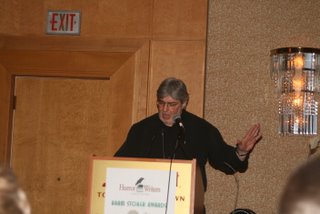 I read like a motherfucker. It is not that I motormouth the tale, I just keep it brisk. I begin quickly because I know near the end there’s a moment when I need a some dead air to give the following some weight. So I establish a pace quick enought to make even a short pause seem like a deathwatch. Later beats lend themselves to breathless rushing. There I do read like a motherfucker.
I make one verbal stumble somewhere along the way, but I keep going.
I speak the tale’s final word (for the record, that word is "Goddamn...!") just as the timekeeper puts his hand on my shoulder. I am in, out and under five by less than a second.
The judges retire to confer. We drink and giggle.
They return.
I do not take third place– the spot I half-way hoped for because there had been some really good writer/readers! I do not take second. I’m done.
I do take first place.
The world is turvy, topsy-wise. We’ve fallen into another version of the Big All.
The prize? Braggin rights, basically. But I am pleased and honored so here I am: Bragging.
I read like a motherfucker.
A joke among my friends is that my titles are longer than some people’s stories: “God Screamed and Screamed, Then I Ate Him.” “’What Do You Know of the Land of Death?’ Clown Said One Night to the Haunted Boy.” “She Was Washing Her Frock When Winston Churchill Came Galloping Out of the Mist.”
That last one got cut down to “Children, Invisible, Watching from the Great Darkness,” but you get the idea.
Not surprisingly, I’m not much for “flash fiction” – short tales, typically begun developed and ended in 500-700 words.
I never intended to enter the flash fiction competition at this year’s World Horror Convention in Toronto. I went to hear some of my friends read. While slicking my hair and tucking my shirt in the room just before the event, though, I remembered a little thing I’d written a year or so ago, one of those things that nudges you when you’re doing something else and you have to put it down. I popped open the computer, dug through the electrons and there it was… 1,246 words titled, “Then, Just Dreaming…” I read it. More than five minutes – the contest limits readers to five minutes and not a heartbeat longer.
I trimmed it…read it again. Still over. Trimmed some more – it wasn’t hard – even at 1,200 words, the story had some flab. I printed it. Went down to the lobby. Read it. Crossed out a few more words then let it go. You can’t do flash fiction, Larry! Hell no. Peter Crowther was judging! So was Ed Bryant. Peter, Ed and Nancy Kilpatrick! Christ no.
I stuck the four pages in my pocket and went in to hear my friends read.
Other chums saw me there.
Chums chuckled. “Santoro at a flash fiction contest!” Big laugh. “No, no,” I say. “I’m just here to watch.”
“Mutually exclusive concepts: Santoro and short fiction! Ha!”
So, I sign up.
I sit. My name is called. I get up. The assembled audients call out the traditional starting signal:
“On your mark! Get set!! READ LIKE A MOTHERFUCKER!!!”
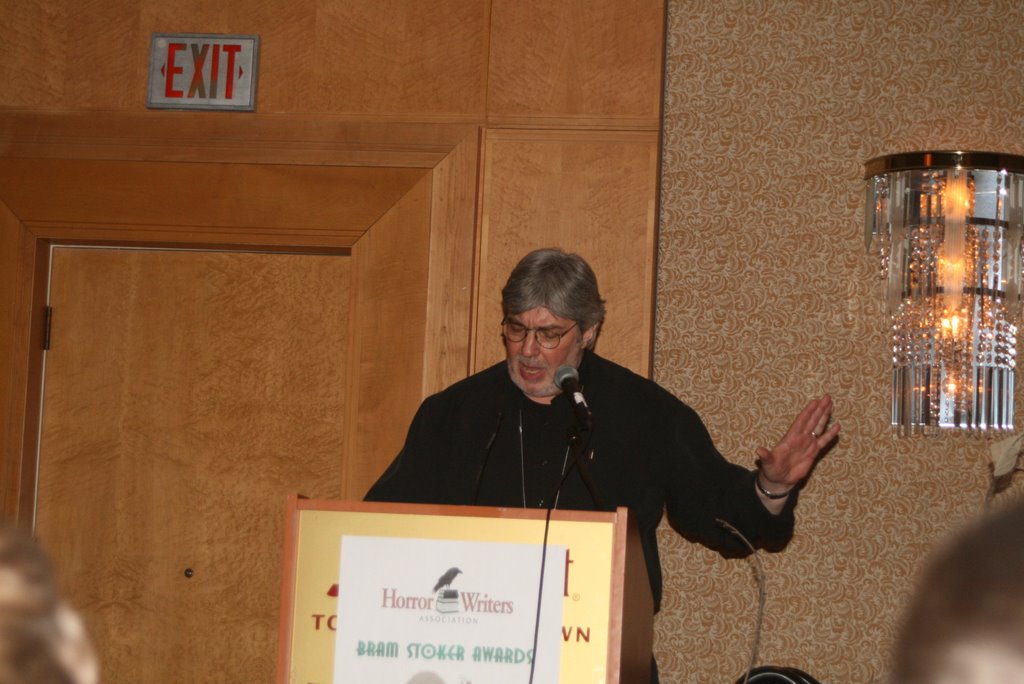 I read like a motherfucker. It is not that I motormouth the tale, I just keep it brisk. I begin quickly because I know near the end there’s a moment when I need a some dead air to give the following some weight. So I establish a pace quick enought to make even a short pause seem like a deathwatch. Later beats lend themselves to breathless rushing. There I do read like a motherfucker.
I make one verbal stumble somewhere along the way, but I keep going.
I speak the tale’s final word (for the record, that word is "Goddamn...!") just as the timekeeper puts his hand on my shoulder. I am in, out and under five by less than a second.
The judges retire to confer. We drink and giggle.
They return.
I do not take third place– the spot I half-way hoped for because there had been some really good writer/readers! I do not take second. I’m done.
I do take first place.
The world is turvy, topsy-wise. We’ve fallen into another version of the Big All.
The prize? Braggin rights, basically. But I am pleased and honored so here I am: Bragging.
I read like a motherfucker.
Tuesday, March 06, 2007

Saturday, March 03, 2007
A Preliminary Look at ISBN - 0-9779049-1-1
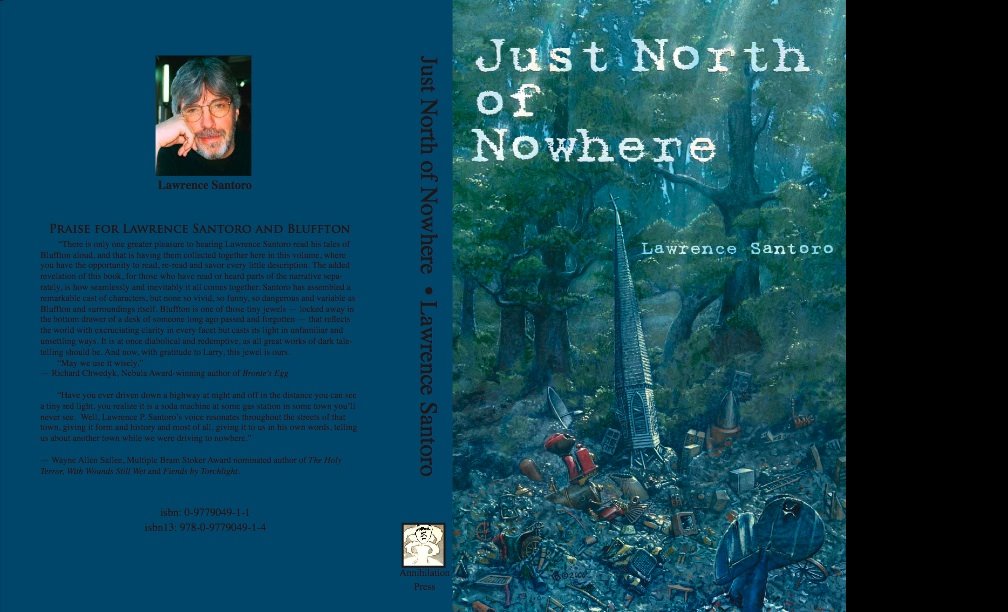 Needless to say, I'm a happy dude. Alan Clark's incredible illustration sets this off beautifully. I love how the typeface lets the light in at the top...
We're still working on layout and having endless fun with Italics, CAPS, font -- my font guru, Kate Campion, where are you now!!!
To think, just a day ago, this is what it all looked like...
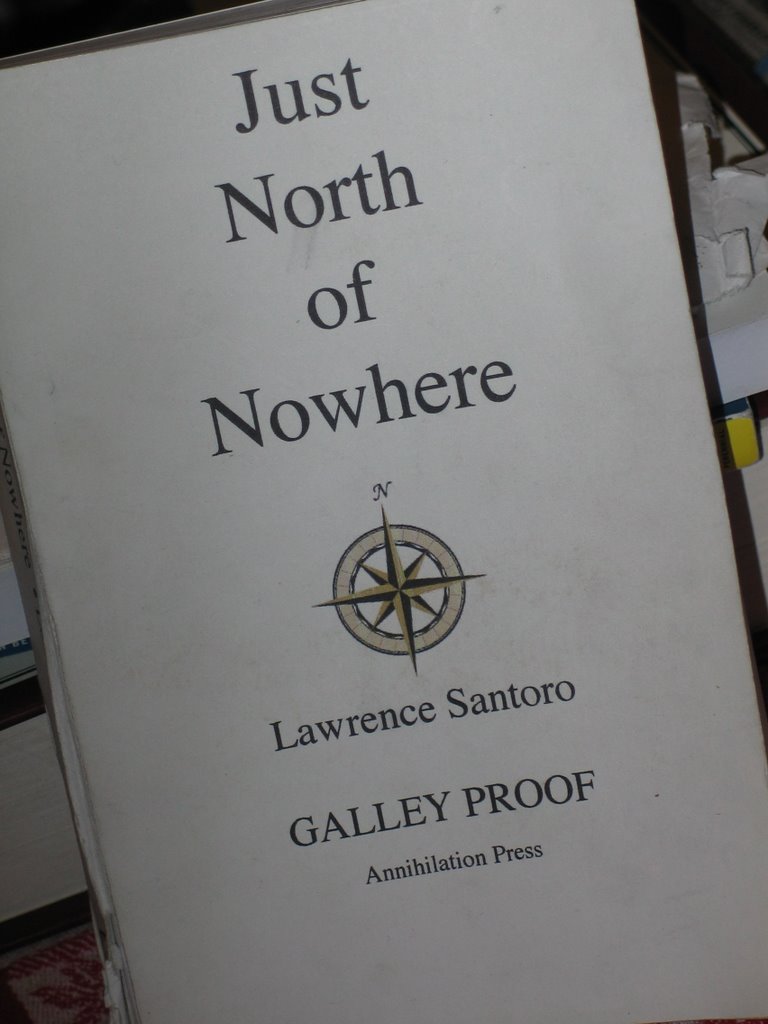
On a separate note: "Just North..." has had a mini-review from Nebula Award winning author Richard Chwedyk who wrote this about it...
"There is only one greater pleasure to hearing Lawrence Santoro read his tales of Bluffton aloud, and that is having them collected together here in this volume, where you have the opportunity to read, re-read and savor every little description. The added revelation of this book, for those who have read or heard parts of the narrative separately, is how seamlessly and inevitably it all comes together. Santoro has assembled a remarkable cast of characters, but none so vivid, so funny, so dangerous and variable as Bluffton and surroundings itself. Bluffton is one of those tiny jewels -- locked away in the bottom drawer of a desk of someone long ago passed and forgotten -- that reflects the world with excruciating clarity in every facet but casts its light in unfamiliar and unsettling ways. It is at once diabolical and redemptive, as all great works of dark tale-telling should be. And now, with gratitude to Larry, this jewel is ours."
"May we use it wisely."
Five-time Bram Stoker nominee, Wayne Allen Sallee said...
"Have you ever driven down a highway at night and off in the distance you can see a tiny red light, you realize it is a soda machine at some gas station in some town you'll never see. Well, Lawrence Santoro's voice resonates throughout the streets of that town, giving it form and history and most of all, giving it to us in his own words, telling us about another town while we were driving to nowhere."
I love the image Wayne conjurs in that. Strangely, it's part of the fetchings of the Bluffton stories. When I used to drive north from Chicago into the driftless to visit an old friend, the last 50 miles were on two-lane blacktops that wound among the mountainettes and bluffs and, from time to time, eased through small dark towns. Late nights, the automata of missing humans -- winking stop lights, wells pumping through the night, and, yes, the patient glow of the soda machines -- in the untenanted places of these buttoned up worlds reminded me of how lonely and how, somehow, American it was to be driving a hole through the middle of the night. American Zen. Something of that, I think, nudged me toward Bluffton.
We're in final proofing. Should be done in about 24 hours -- give or take a lifetime and a few billion synaptic coffee-jangled misfires. This is harder than writing the damn thing but we're working our asses off to get "Just North..." ready for the World Horror Convention in Toronto at the end of this month. It'll be a hump but Roger Trexler -- the publisher -- is certain we can do it!
If we can't I've got a rusty razor in the cupboard, dulled and waiting!
Saturday, January 27, 2007
A DARK AND DEADLY VALLEY - The Flip-Side
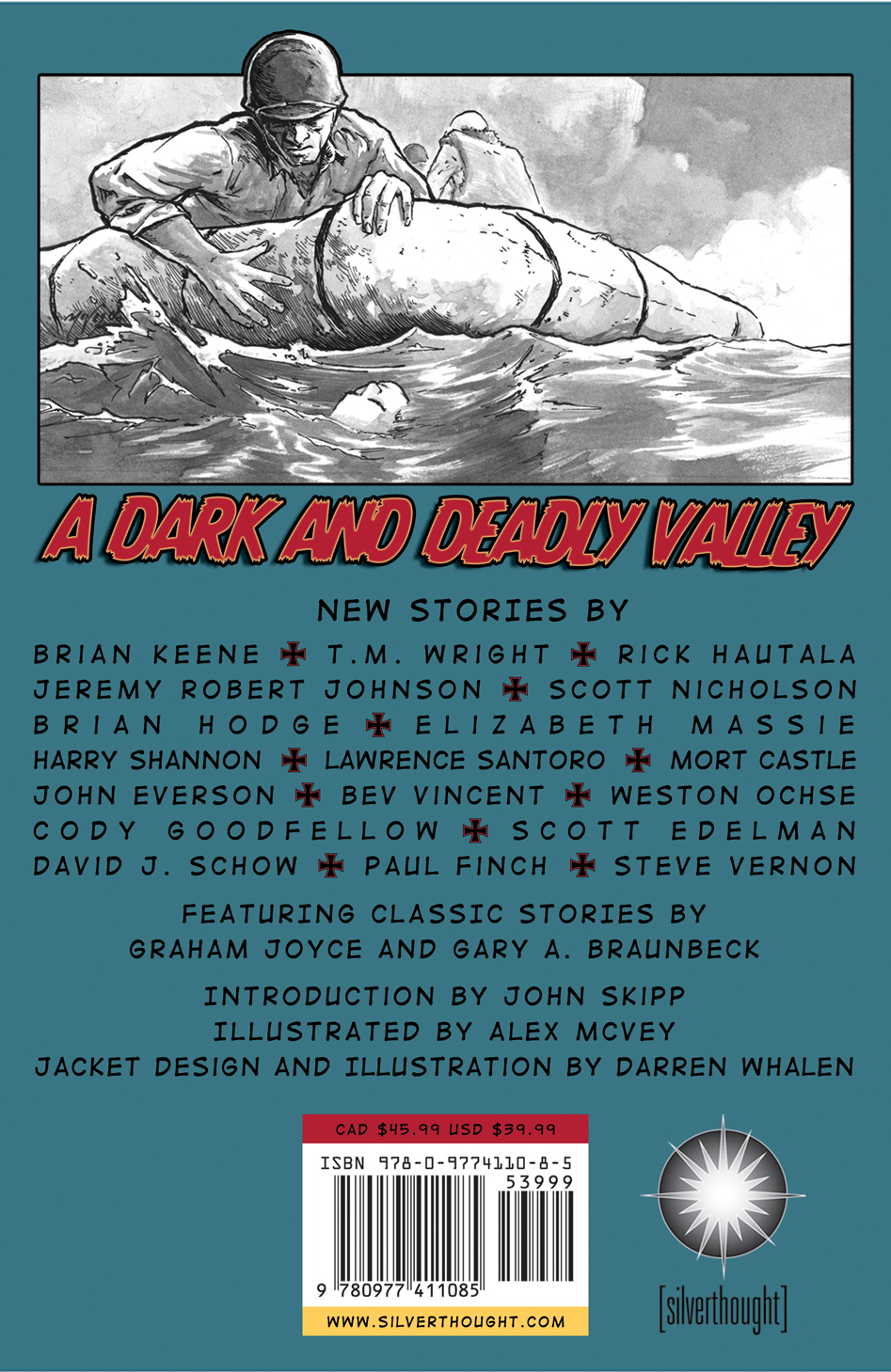 Behold. The back cover to Mike Heffernan's anthology A DARK AND DEADLY VALLY, due out from Silverthought Press in February of this year.
I just got the galleys to it -- and to the Bluffton book, JUST NORTH OF NOWHERE -- and am up to my limpid's in commas and re-spellings.
I would like to post Alex McVey's illustration for my story, "At Angels Sixteen" but I haven't a clue how to do it. The world of electrons is getting harder and harder for Old-Century types like me to fiddle!
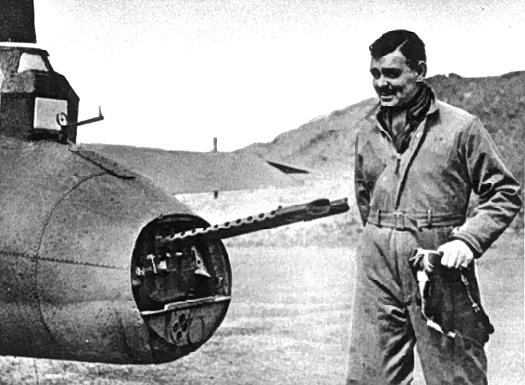
"At Angels Sixteen" centers on the tail gunner of a B-17 Flying Fortress who faces some elemental problems staying alive over Schweinfurt during the air war in Europe. I can't show Alex's very shiny art, but this...
 ...this is the critter, herself.
I've always been a little in love with the -17s; actually saved nickles and dimes and bought a big picture book about them when I was 7 or 8; actually been IN the tail of one; actually aloft in her -- a dry run, a just for fun run, nobody shooting. No payload. I was maybe five. The year was maybe 1947 or '48 and my dad and I were at an air show at Spaatz Field in Reading, Pennsylvania. A lot of 17s were left back then. I think they were still in the arsenal at the time but my old man wangled us a spin. Maybe it was my uncle Bohny -- that's pronounced "Boney" -- who was a captain in the Corps and a pretty scary guy.
It's all vague but the ride! The ride was scary and wonderful! Chattery, windy, like riding a boxcar with loose slats on a curvy stretch of bad rail. Of course I loved it!
I've never spoken to a single -17 crew guy from the war who hasn't choked a little, remembering. Remembering what? The ride, the guys, the time. Of course they were soldiers then and young...we all choke up over youth.
As of January, 2007, there are only 14 of the old Forts still flying...
Hell, why am I nostalgic over an old warbird? My youth? I was near enough to smell it but was never in the shit. War is good for a horror tale or two but that's is as close as I ever wanted to be; as close as anyone ever should be.
Sunday, January 07, 2007
Another Book, Upcoming Readings and Some Added News
 This funny old place carries a lot of personal and public history. I'll tell you about it...
But that's the new book...
Here's a quick note to let you know that I've got two readings in Chicago this month in advance of the publication of "Just North of Nowhere," and my story in A DARK AND DEADLY VALLEY.
The first is on Thursday, January 18th at 7:30pm at Cafe Ennui, 6981 North Sheridan Road.
The second is on Monday, January 29th also at 7:30 at The Red Lion Pub, 2446 North Lincoln Avenue. This is the Twilight Tales venue. Later this year, Twilight Tales will publish a revamped and expanded version of their anthology, TALES FROM THE RED LION. I'm pleased to report that TALES... will include a somewhat updated version of my story, "Cordwell's Book."
Stop by have a listen. You can also stop by Twilight Tales online and buggle about and find some really nifty stuff! In addition to stories, information, good people with whom to chat, they've also got podcasts...the which include my story, "Little Girl Down the Way." It all begins at: www.twilighttales.com
Some new business...

The photos. They're settings. Locations for a new book I've been fussing with most of my adult life. I'm finally sitting down to write it -- not that I haven't done so before. Oh, I have...plenty of times. I've got hundreds of pages about these places. Problem is, they were unfocused, they were little time trips. It's taken a while, but I think I have a handle on the places and the people and am beginning to figure out what they're trying to say.
This greens-topped birthcanal back alley is the start of a lot of stories.

It's where we found ourselves and figured out what we could do, what we couldn't do...and what scared the hell out of us.
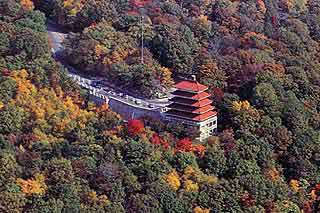
Quite a few of them find their way here...
The reading at Ennui on January 18, will be from this new book. It doesn't yet have a title but it's working-tag is "The Dogboys and WAS..." By the way, WAS is prounounced 'Whaz' -- as in 'whazoo' -- and, yes, we get that information the first time we encouter WAS!
I hope it tickles your urges! Hope you stop by Ennui and The Lion.
Thursday, November 02, 2006
A DARK AND DEADLY VALLEY
January, 2007, is shaping up to be a big month for me.
My Bluffton collection, "Just North of Nowhere," is due out from Annihilation Press about then. So, too, I'm now told is my longish short story (do I do anything but?) "At Angels Sixteen" in the Mike Heffernan-edited A DARK AND DEADLY VALLEY. (Brownie points for anyone who can identify the source of that title without looking it up! )
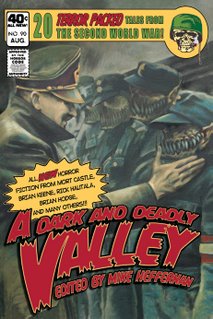
You've probably sussed the fact that ADDV is a collection of stories set in and around World War II. My contribution, "At Angels Sixteen," is a story I wrote about 8 years ago (and, typically, never tried to sell). The central character is the tail gunner in a B-17 Flying Fortress who encounters more than flak and the Luftwaffe in the skies over Germany!
Mike's put together an incredible line-up of talent for this book and I'm honored to be part of it. Take a look:
"After Dunkirk" by T.M Wright
"The Coventry Boy" by Graham Joyce
"The Honor Guard" by Paul Finch
"In the Dark and the Deep" by Steve Vernon
"Simple Equations" by Jeremy Robert Johnson
"The Night is an Ally" by Scott Nicholson
"Come Unto Me" by Elizabeth Massie
"And the Worm Shall Feed" by Harry Shannon
"At Angels Sixteen" by my own self, Lawrence Santoro
"The Black Wave" by Brian Keene
"And They Will Come in the Hour of Our Greatest Need" by Brian Hodge
"The Devil's Platoon" by John Everson
"Sturm und Drang" by Bev Vincent
"Hiroshima Falling" by Weston Ochse
"Doorway to the Sky" by Cody Goodfellow
"A Judgment Call for Judgment Day" by Scott Edelman
"Blossoms in the Wind" by Rick Hautala
"The Gypsy Camp" by Mort Castle
"Warbirds" by David J. Schow
"But Somewhere I Shall Wake" by Gary A. Braunbeck
Stop by this site: http://www.silverthought.com/preddv.html or click on the title above the post and check it out...
I'm told that books like this get snapped up by collectors like/THAT! So order early!
My Bluffton collection, "Just North of Nowhere," is due out from Annihilation Press about then. So, too, I'm now told is my longish short story (do I do anything but?) "At Angels Sixteen" in the Mike Heffernan-edited A DARK AND DEADLY VALLEY. (Brownie points for anyone who can identify the source of that title without looking it up! )

You've probably sussed the fact that ADDV is a collection of stories set in and around World War II. My contribution, "At Angels Sixteen," is a story I wrote about 8 years ago (and, typically, never tried to sell). The central character is the tail gunner in a B-17 Flying Fortress who encounters more than flak and the Luftwaffe in the skies over Germany!
Mike's put together an incredible line-up of talent for this book and I'm honored to be part of it. Take a look:
"After Dunkirk" by T.M Wright
"The Coventry Boy" by Graham Joyce
"The Honor Guard" by Paul Finch
"In the Dark and the Deep" by Steve Vernon
"Simple Equations" by Jeremy Robert Johnson
"The Night is an Ally" by Scott Nicholson
"Come Unto Me" by Elizabeth Massie
"And the Worm Shall Feed" by Harry Shannon
"At Angels Sixteen" by my own self, Lawrence Santoro
"The Black Wave" by Brian Keene
"And They Will Come in the Hour of Our Greatest Need" by Brian Hodge
"The Devil's Platoon" by John Everson
"Sturm und Drang" by Bev Vincent
"Hiroshima Falling" by Weston Ochse
"Doorway to the Sky" by Cody Goodfellow
"A Judgment Call for Judgment Day" by Scott Edelman
"Blossoms in the Wind" by Rick Hautala
"The Gypsy Camp" by Mort Castle
"Warbirds" by David J. Schow
"But Somewhere I Shall Wake" by Gary A. Braunbeck
Stop by this site: http://www.silverthought.com/preddv.html or click on the title above the post and check it out...
I'm told that books like this get snapped up by collectors like/THAT! So order early!
Saturday, October 28, 2006
JUST NORTH OF NOWHERE
I put this picture up earlier, months ago in fact, back when Alan Clark finished it. This is the cover illustration for my book, JUST NORTH OF NOWHERE. 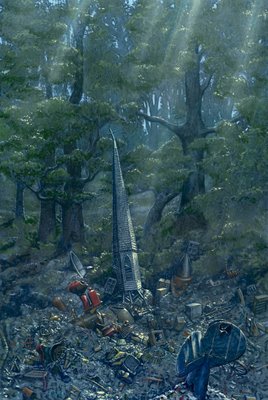
Needless to say, I love the painting. It's an image from the chapter called "The Ninth Goddamned Kid."
Still not sure of the publication date but we're shooting for early 2007.
For those of you who have read or heard any of the "Bluffton" stories, this is a collection that doesn't quite exhaust the supply -- yes, there are a few more in the trunk -- but these are the ones that currently fit into a comfortable sequence, one with the other! It's damn-near a novel for cripes' sake!
If any of you are only familiar with my "vile tales" such as :"Little Girl Down the Way," or "Catching" (from the SEX CRIMES anthology -- and even I shudder at that one -- the story and the book!) then the Bluffton stories may surprise you.

Needless to say, I love the painting. It's an image from the chapter called "The Ninth Goddamned Kid."
Still not sure of the publication date but we're shooting for early 2007.
For those of you who have read or heard any of the "Bluffton" stories, this is a collection that doesn't quite exhaust the supply -- yes, there are a few more in the trunk -- but these are the ones that currently fit into a comfortable sequence, one with the other! It's damn-near a novel for cripes' sake!
If any of you are only familiar with my "vile tales" such as :"Little Girl Down the Way," or "Catching" (from the SEX CRIMES anthology -- and even I shudder at that one -- the story and the book!) then the Bluffton stories may surprise you.
Wednesday, October 18, 2006
This WILL Make Sense

Soon, sometime soon, I'll explain.
Okay. I'll explain a little of it now: I turned in the ms. for "Just North of Nowhere" last night. Well, okay: ms. is a misnomer. I turned in the file, sent the disc. Except for individual chapters and tales that I've printed out for readings, the book hasn't seen paper YET! But the publisher has the words, the virtual pages! All 499 of them.
This doesn't mean I'm finished. Oh no! Lots left to do, and after that, more! Lots more to sell the thing. Hopefully we'll have the book out, well, soon! In time for NEXT Christmas!!
The picture: it's one of the bluffs of the REAL Bluffton -- the name of which I will not say. Not here. Not yet.
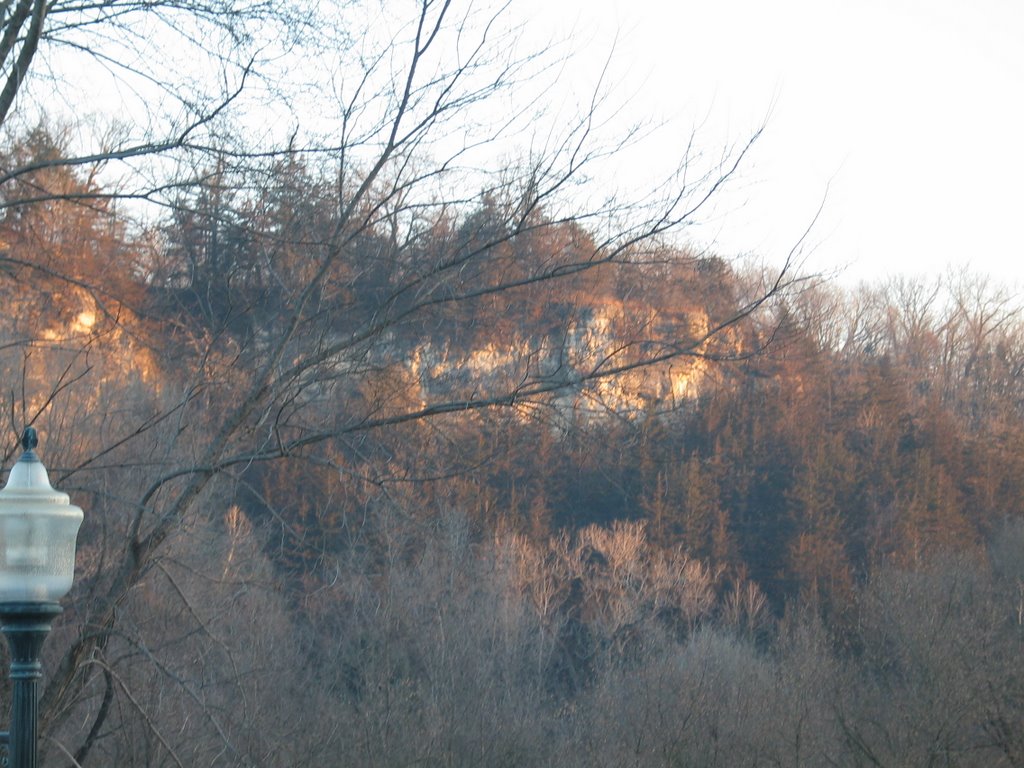
The other picture is another bluff. Bluffton's surrounded by them. See? I wasn't kidding. The Driftless is real!
Okay. More later. I'm exhausted. Back in a bit.
Monday, October 02, 2006
Deep in the Heart of Texas
Okay. Summer's over. The Cubs won their last game and the team's been disbanded for the season. See you next summer all you suburban yutzes that have pissed in my alley and puked on my stoop and stood around in an alcoholic daze wondering how we city-dwellers could live in such dirty surroundings.
Anyway. IT is nearly finished. That's right: the book's almost done and I'll soon be back to solo blogging. In the meantime...here's a pitiful story out of Texas from the Dallas Morning News.
I WAS going to post a report on the Religious Nut convention, the "Values Voter Summit" that took place in Washington DC on September 22-23, but I just couldn't. Really...I was so furious, so shakingly terrified for the future of the country, that I couldn't bring myself to post it.
Frisco teacher on leave after museum trip
Art instructor who led museum trip will not have contract renewed
07:23 AM CDT on Tuesday, September 26, 2006
By KAREN AYRES / The Dallas Morning News
FRISCO – An elementary school art teacher who has been publicly at odds with the Frisco school district over a field trip to the Dallas Museum of Art is no longer in front of a classroom.
The school district placed Sydney McGee on leave with pay Friday afternoon. After a special school board meeting Monday night about Ms. McGee, Superintendent Rick Reedy said he would recommend that her contract not be renewed when it expires at the end of the school year.
In the meantime, Ms. McGee will be paid her full salary while remaining on leave from Fisher Elementary School.
Ms. McGee's attorney, Rogge Dunn, said the decision was a "crazy use of taxpayers' money."
"She wants to be in there with her kids," Mr. Dunn said.
A Frisco ISD spokeswoman said the district had no further comments on the case.
Ms. McGee, a 28-year veteran teacher, contends she was retaliated against after a parent complained that a student saw a nude statue during a field trip to the museum in April.
District officials have repeatedly pointed to other performance issues and said the trip didn't spark the reprimands.
Ms. McGee became the subject of frequent media reports over the last month after the board rejected her August request to transfer to another Frisco school.
District officials said they didn't want to give Ms. McGee an escape hatch to move elsewhere without addressing other issues, including lesson-plan preparation.
But Ms. McGee said she received a negative review and several directives from Fisher principal Nancy Lawson only after a parent reportedly complained about the trip.
The school board stopped short of terminating Ms. McGee's contract Monday night. But after a closed-door session, Dr. Reedy said he would recommend that her contract not be renewed.
"If they had good reason to fire her, they would have, but they don't," Mr. Dunn said. "It's mind-boggling."
Buddy Minett, school board president, declined to talk about the case.
"This is something where it's really better if we don't comment," he said.
Mr. Dunn said he and Ms. McGee plan to review their legal options.
E-mail kayres@dallasnews.com
Anyway. IT is nearly finished. That's right: the book's almost done and I'll soon be back to solo blogging. In the meantime...here's a pitiful story out of Texas from the Dallas Morning News.
I WAS going to post a report on the Religious Nut convention, the "Values Voter Summit" that took place in Washington DC on September 22-23, but I just couldn't. Really...I was so furious, so shakingly terrified for the future of the country, that I couldn't bring myself to post it.
Frisco teacher on leave after museum trip
Art instructor who led museum trip will not have contract renewed
07:23 AM CDT on Tuesday, September 26, 2006
By KAREN AYRES / The Dallas Morning News
FRISCO – An elementary school art teacher who has been publicly at odds with the Frisco school district over a field trip to the Dallas Museum of Art is no longer in front of a classroom.
The school district placed Sydney McGee on leave with pay Friday afternoon. After a special school board meeting Monday night about Ms. McGee, Superintendent Rick Reedy said he would recommend that her contract not be renewed when it expires at the end of the school year.
In the meantime, Ms. McGee will be paid her full salary while remaining on leave from Fisher Elementary School.
Ms. McGee's attorney, Rogge Dunn, said the decision was a "crazy use of taxpayers' money."
"She wants to be in there with her kids," Mr. Dunn said.
A Frisco ISD spokeswoman said the district had no further comments on the case.
Ms. McGee, a 28-year veteran teacher, contends she was retaliated against after a parent complained that a student saw a nude statue during a field trip to the museum in April.
District officials have repeatedly pointed to other performance issues and said the trip didn't spark the reprimands.
Ms. McGee became the subject of frequent media reports over the last month after the board rejected her August request to transfer to another Frisco school.
District officials said they didn't want to give Ms. McGee an escape hatch to move elsewhere without addressing other issues, including lesson-plan preparation.
But Ms. McGee said she received a negative review and several directives from Fisher principal Nancy Lawson only after a parent reportedly complained about the trip.
The school board stopped short of terminating Ms. McGee's contract Monday night. But after a closed-door session, Dr. Reedy said he would recommend that her contract not be renewed.
"If they had good reason to fire her, they would have, but they don't," Mr. Dunn said. "It's mind-boggling."
Buddy Minett, school board president, declined to talk about the case.
"This is something where it's really better if we don't comment," he said.
Mr. Dunn said he and Ms. McGee plan to review their legal options.
E-mail kayres@dallasnews.com
Friday, September 15, 2006
*SIGH*
Still hard a-work on "Just North of Nowhere" but I thought I'd post this little piece of wishful thinking from -- of all places -- Newsweek magazine!
An Alternate 9/11 History
By staying 'humble,' as he promised in 2000, Bush preserved much of the post-9/11 good will abroad.
By Jonathan Alter
Newsweek
Sept. 18, 2006 issue - Five years after 9/11, the world is surprisingly peaceful. President Bush's pragmatic and bipartisan leadership has kept the United States not just strong but unexpectedly popular across the globe. The president himself is poised to enjoy big GOP wins in the midterm elections, a validation of his subtle understanding of the challenges facing the country. A new survey of historians puts him in the first tier of American presidents.
As Bush warned, catching terrorists wasn't easy, but he kept at it. At the battle of Tora Bora, CIA operatives on the ground cabled Washington that Osama bin Laden was cornered, but they desperately needed troop support. Defense Secretary Donald Rumsfeld immediately dispatched fresh forces, and the evildoer was killed. While bin Laden was seen as a martyr in a few isolated areas, the bulk of the Arab world had been in sympathy with the United States after 9/11 and shed no tears. After their capture, Khalid Shaikh Mohammed and other 9/11 terrorists were transported to the United States, where they were tried and quickly executed.
Today, Al Qaeda remains a threat but its opportunities for recruitment have been scarce, and the involvement of the entire international community has helped dramatically reduce terrorist attacks worldwide. Because Bush believes diplomacy requires talking to adversaries as well as friends, even Syria and Iraq were forced to help. By staying "humble," as he promised in 2000, he preserved much of the post-9/11 good feeling abroad, which paid dividends when it came time to pull together a coalition to handle North Korea and Iran.
At home, some aides suggested that Bush simply tell the nation to "go shopping." But the president knew he had a precious opportunity to ask Americans for real sacrifice. He took John McCain's suggestion and pushed through Congress an ambitious national-service program that bolstered communities and helped train citizens as first responders.
Soon Bush put the country on a Manhattan Project crash course to get off oil. He bluntly told Detroit that it was embarrassing that Chinese automakers had better fuel efficiency, he classified SUVs as cars, and he imposed a stiff gas tax with a rebate for the working poor. To pay for it, he abandoned his tax cuts for the wealthy, reminding the country that no president in history had ever cut taxes in the middle of a war. This president would be damned if he was going to put more oil money into the pockets of Middle Eastern hatemongers who had killed nearly 3,000 of our people. To dramatize the point, he drove to his 2002 State of the Union address in a hybrid car. Sales soared.
When Karl Rove suggested that the war on terror would make a perfect wedge issue against Democrats in the 2002 midterms, Bush brought him up short. Didn't Rove understand that bipartisanship is good politics? Lincoln and FDR had both gone bipartisan during wartime, he reminded his aide. So when evidence of torture at the prison camp in Guantánamo Bay surfaced and Rumsfeld was forced to resign, former Democratic senator Sam Nunn got the job. With post-9/11 unity still at least partially intact in 2004, Bush was re-elected in a landslide.
Taking a cue from Lincoln's impatience with his generals, Bush was merciless about poor performance on homeland security. When the head of the FBI couldn't fix the bureau's computers in a year's time to "connect the dots," he was out. And Bush had no patience for excuse-making about leaky port security, unsecured chemical plants and first responders whose radios didn't communicate. If someone had told him that five years after 9/11 these problems would still be unsolved, Bush would have laughed him out of the office.
In 2003, Vice President Cheney advised the president to take out Iraq's Saddam Hussein militarily. But Bush was beginning to understand that his veep, while sounding full of gravitas, was in fact reckless. When it became clear that Saddam posed no imminent threat, Bush resolved to neuter him, Kaddafi style. When the president found, after a little asking around, that the 10-year cost of invading Iraq would be a crushing $1.2 trillion, he opted out of this war of choice.
Five years after that awful September day, even Bush's fiercest critics have learned an important lesson: leadership counts. Imagine if we'd done the opposite of these things. This country—and the world—would be in a heap of trouble.
URL: http://www.msnbc.msn.com/id/14753927/site/newsweek/
An Alternate 9/11 History
By staying 'humble,' as he promised in 2000, Bush preserved much of the post-9/11 good will abroad.
By Jonathan Alter
Newsweek
Sept. 18, 2006 issue - Five years after 9/11, the world is surprisingly peaceful. President Bush's pragmatic and bipartisan leadership has kept the United States not just strong but unexpectedly popular across the globe. The president himself is poised to enjoy big GOP wins in the midterm elections, a validation of his subtle understanding of the challenges facing the country. A new survey of historians puts him in the first tier of American presidents.
As Bush warned, catching terrorists wasn't easy, but he kept at it. At the battle of Tora Bora, CIA operatives on the ground cabled Washington that Osama bin Laden was cornered, but they desperately needed troop support. Defense Secretary Donald Rumsfeld immediately dispatched fresh forces, and the evildoer was killed. While bin Laden was seen as a martyr in a few isolated areas, the bulk of the Arab world had been in sympathy with the United States after 9/11 and shed no tears. After their capture, Khalid Shaikh Mohammed and other 9/11 terrorists were transported to the United States, where they were tried and quickly executed.
Today, Al Qaeda remains a threat but its opportunities for recruitment have been scarce, and the involvement of the entire international community has helped dramatically reduce terrorist attacks worldwide. Because Bush believes diplomacy requires talking to adversaries as well as friends, even Syria and Iraq were forced to help. By staying "humble," as he promised in 2000, he preserved much of the post-9/11 good feeling abroad, which paid dividends when it came time to pull together a coalition to handle North Korea and Iran.
At home, some aides suggested that Bush simply tell the nation to "go shopping." But the president knew he had a precious opportunity to ask Americans for real sacrifice. He took John McCain's suggestion and pushed through Congress an ambitious national-service program that bolstered communities and helped train citizens as first responders.
Soon Bush put the country on a Manhattan Project crash course to get off oil. He bluntly told Detroit that it was embarrassing that Chinese automakers had better fuel efficiency, he classified SUVs as cars, and he imposed a stiff gas tax with a rebate for the working poor. To pay for it, he abandoned his tax cuts for the wealthy, reminding the country that no president in history had ever cut taxes in the middle of a war. This president would be damned if he was going to put more oil money into the pockets of Middle Eastern hatemongers who had killed nearly 3,000 of our people. To dramatize the point, he drove to his 2002 State of the Union address in a hybrid car. Sales soared.
When Karl Rove suggested that the war on terror would make a perfect wedge issue against Democrats in the 2002 midterms, Bush brought him up short. Didn't Rove understand that bipartisanship is good politics? Lincoln and FDR had both gone bipartisan during wartime, he reminded his aide. So when evidence of torture at the prison camp in Guantánamo Bay surfaced and Rumsfeld was forced to resign, former Democratic senator Sam Nunn got the job. With post-9/11 unity still at least partially intact in 2004, Bush was re-elected in a landslide.
Taking a cue from Lincoln's impatience with his generals, Bush was merciless about poor performance on homeland security. When the head of the FBI couldn't fix the bureau's computers in a year's time to "connect the dots," he was out. And Bush had no patience for excuse-making about leaky port security, unsecured chemical plants and first responders whose radios didn't communicate. If someone had told him that five years after 9/11 these problems would still be unsolved, Bush would have laughed him out of the office.
In 2003, Vice President Cheney advised the president to take out Iraq's Saddam Hussein militarily. But Bush was beginning to understand that his veep, while sounding full of gravitas, was in fact reckless. When it became clear that Saddam posed no imminent threat, Bush resolved to neuter him, Kaddafi style. When the president found, after a little asking around, that the 10-year cost of invading Iraq would be a crushing $1.2 trillion, he opted out of this war of choice.
Five years after that awful September day, even Bush's fiercest critics have learned an important lesson: leadership counts. Imagine if we'd done the opposite of these things. This country—and the world—would be in a heap of trouble.
URL: http://www.msnbc.msn.com/id/14753927/site/newsweek/
Wednesday, August 09, 2006
LITTLE GIRL
Of course I Google myself! And NO that doesn't mean THAT! Having done so recently -- just for curiosity, you understand -- I noted a site that linked to the podcast of "Little Girl Down the Way."
I'm trying to post it here. I have no idea if this will work -- if my previous history with this kind of stuff is any indication of the future, it won't -- but there we are. Go here: http://www.odeo.com/audio/631294/view
IF you can get there...have a listen and let me know what you think.
I'm trying to post it here. I have no idea if this will work -- if my previous history with this kind of stuff is any indication of the future, it won't -- but there we are. Go here: http://www.odeo.com/audio/631294/view
IF you can get there...have a listen and let me know what you think.
Friday, August 04, 2006
Control Alt Delete Democracy
Still working on JUST NORTH OF NOWHERE so I'm still having my blog guest-written. This is from the Long Island Press:
Control Alt Delete Democracy
Lazlow 08/03/2006 11:46 am
I am terribly unimpressed with the future. I don’t have a jet pack or a space car. I have to wait in line and be felt up for minimum wage before sitting on the tarmac for hours and then riding in an airborne cattle car with sweaty fat people and $5- snack boxes. Teleportation was supposed to be here. My car was supposed to fit in my suitcase. Robot maids stink. I’ve been through several robot maids, Roombas and Aibos alike. The future to me seems a lot like the past, except I can’t smoke at concerts, all the girls you think are real are fake, and there’s still nothing on TV.
I can, if I want, go online and vote against Bill Gates as CEO of Microsoft. If you own shares of any company, a proxy vote notification arrives via e-mail, and you log in, vote, and you’re done. It’s democracy that takes minutes. Why then is e-voting in this country the equivalent of a 50-car pileup with a gas tanker?
After the election mess of 2000, where tens of thousands of people in Florida were (oops) accidentally dropped off the voting rolls, 2004 saw a colossal failure of e-voting machines. And this next election will be no different.
American taxpayers have paid for hundreds of millions of dollars worth of computerized voting machines that are screaming for fraud and vote manipulation.
Diebold, the manufacturer of most of the e-voting machines in the country, even had a CEO in 2004 who promised to deliver Ohio to Bush. Ohio is still having issues.
According to CNN, in Cuyahoga County, Ohio, an election held on May 2 was an absolute failure, as Diebold e-voting machines dropped or displaced several hundred registered voters, froze up, or crashed.
Now some hacker activists have exposed a horrifying flaw with Diebold machines. After examining one of the most popular (and paperless) touch-screen voting machines used in public elections in the United States, Open Voting Foundation President Alan Dechert says the group found that by flipping a single switch inside, an election can be altered. “If you have access to these machines and you want to rig an election, anything is possible with the Diebold TS — and it could be done without leaving a trace. All you need is a screwdriver.”
Diebold has fought efforts for mandatory paper trails. I mean, it’s the future! Why double check? Diebold has also fought efforts to publish their code so democracy can be open source, published for the record and analyzed for flaws. Computer professor Avi Rubin at Johns Hopkins University studied the code and told CBS, “We found all kinds of problems in the code,” he said. “A computer scientist can look at a program and immediately tell you if it was written by professional programmers who know how to do software engineering or if it was just put together by a bunch of hacks. And, upon looking at the source code for Diebold, it was pretty clear that this was a real amateur job.”
Counting the votes is a core component of democracy. If e-voting is the future of elections, I’m not impressed.
--
Lazlow hosts the nationally syndicated radio program "Technofile" and wrote and produced audio for "Grand Theft Auto: San Andreas."
Contact him at Lazlow@lazlow.com.
Control Alt Delete Democracy
Lazlow 08/03/2006 11:46 am
I am terribly unimpressed with the future. I don’t have a jet pack or a space car. I have to wait in line and be felt up for minimum wage before sitting on the tarmac for hours and then riding in an airborne cattle car with sweaty fat people and $5- snack boxes. Teleportation was supposed to be here. My car was supposed to fit in my suitcase. Robot maids stink. I’ve been through several robot maids, Roombas and Aibos alike. The future to me seems a lot like the past, except I can’t smoke at concerts, all the girls you think are real are fake, and there’s still nothing on TV.
I can, if I want, go online and vote against Bill Gates as CEO of Microsoft. If you own shares of any company, a proxy vote notification arrives via e-mail, and you log in, vote, and you’re done. It’s democracy that takes minutes. Why then is e-voting in this country the equivalent of a 50-car pileup with a gas tanker?
After the election mess of 2000, where tens of thousands of people in Florida were (oops) accidentally dropped off the voting rolls, 2004 saw a colossal failure of e-voting machines. And this next election will be no different.
American taxpayers have paid for hundreds of millions of dollars worth of computerized voting machines that are screaming for fraud and vote manipulation.
Diebold, the manufacturer of most of the e-voting machines in the country, even had a CEO in 2004 who promised to deliver Ohio to Bush. Ohio is still having issues.
According to CNN, in Cuyahoga County, Ohio, an election held on May 2 was an absolute failure, as Diebold e-voting machines dropped or displaced several hundred registered voters, froze up, or crashed.
Now some hacker activists have exposed a horrifying flaw with Diebold machines. After examining one of the most popular (and paperless) touch-screen voting machines used in public elections in the United States, Open Voting Foundation President Alan Dechert says the group found that by flipping a single switch inside, an election can be altered. “If you have access to these machines and you want to rig an election, anything is possible with the Diebold TS — and it could be done without leaving a trace. All you need is a screwdriver.”
Diebold has fought efforts for mandatory paper trails. I mean, it’s the future! Why double check? Diebold has also fought efforts to publish their code so democracy can be open source, published for the record and analyzed for flaws. Computer professor Avi Rubin at Johns Hopkins University studied the code and told CBS, “We found all kinds of problems in the code,” he said. “A computer scientist can look at a program and immediately tell you if it was written by professional programmers who know how to do software engineering or if it was just put together by a bunch of hacks. And, upon looking at the source code for Diebold, it was pretty clear that this was a real amateur job.”
Counting the votes is a core component of democracy. If e-voting is the future of elections, I’m not impressed.
--
Lazlow hosts the nationally syndicated radio program "Technofile" and wrote and produced audio for "Grand Theft Auto: San Andreas."
Contact him at Lazlow@lazlow.com.
Wednesday, July 19, 2006
Custodians of Chaos
Still to the eyeballs in bits and pieces of "Bluffton" trying to get JUST NORTH OF NOWHERE ready for publication this November, I'm letting others do my talking for me.

Look, I never intended this space to be a political platform but too much of the country I was born into is slipping away right now, being gobbled up by the 'PPs' today's 'guest' writer speaks of.
This is an extract from Kurt Vonnegut's forthcoming memoirs. The image is from IN THESE TIMES:
06/17/06 "Information Clearing House" -- -- "Do unto others what you would have them do unto you." A lot of people think Jesus said that, because it is so much the sort of thing Jesus liked to say. But it was actually said by Confucius, a Chinese philosopher, five hundred years before there was that greatest and most humane of human beings, named Jesus Christ.
The Chinese also gave us, via Marco Polo, pasta and the formula for gunpowder. The Chinese were so dumb they only used gunpowder for fireworks. And everybody was so dumb back then that nobody in either hemisphere even knew that there was another one.
We've sure come a long way since then. Sometimes I wish we hadn't. I hate H-bombs and the Jerry Springer Show
But back to people like Confucius and Jesus and my son the doctor, Mark, each of whom have said in their own way how we could behave more humanely and maybe make the world a less painful place. One of my favourite humans is Eugene Debs, from Terre Haute in my native state of Indiana.
Get a load of this. Eugene Debs, who died back in 1926, when I was not yet four, ran five times as the Socialist party candidate for president, winning 900,000 votes, almost 6 percent of the popular vote, in 1912, if you can imagine such a ballot. He had this to say while campaigning:
"As long as there is a lower class, I am in it.
"As long as there is a criminal element, I am of it.
"As long as there is a soul in prison, I am not free."
Doesn't anything socialistic make you want to throw up? Like great public schools, or health insurance for all?
When you get out of bed each morning, with the roosters crowing, wouldn't you like to say. "As long as there is a lower class, I am in it. As long as there is a criminal element, I am of it. As long as there is a soul in prison, I am not free."
How about Jesus' Sermon on the Mount, the Beatitudes?
Blessed are the meek, for they shall inherit the Earth.
Blessed are the merciful, for they shall obtain mercy.
Blessed are the peacemakers, for they shall be called the children of God.
And so on.
Not exactly planks in a Republican platform. Not exactly George W Bush, Dick Cheney, or Donald Rumsfeld stuff.
For some reason, the most vocal Christians among us never mention the Beatitudes. But, often with tears in their eyes, they demand that the Ten Commandments be posted in public buildings. And of course that's Moses, not Jesus. I haven't heard one of them demand that the Sermon on the Mount, the Beatitudes, be posted anywhere.
"Blessed are the merciful" in a courtroom? "Blessed are the peacemakers" in the Pentagon? Give me a break!
It so happens that idealism enough for anyone is not made of perfumed pink clouds. It is the law! It is the US Constitution.
But I myself feel that our country, for whose Constitution I fought in a just war, might as well have been invaded by Martians and body snatchers. Sometimes I wish it had been. What has happened instead is that it was taken over by means of the sleaziest, low-comedy, Keystone Cops-style coup d'état imaginable.
I was once asked if I had any ideas for a really scary reality TV show. I have one reality show that would really make your hair stand on end: "C-Students from Yale".
George W Bush has gathered around him upper-crust C-students who know no history or geography, plus not-so-closeted white supremacists, aka Christians, and plus, most frighteningly, psychopathic personalities, or PPs, the medical term for smart, personable people who have no consciences.
To say somebody is a PP is to make a perfectly respectable diagnosis, like saying he or she has appendicitis or athlete's foot. The classic medical text on PPs is The Mask of Sanity by Dr Hervey Cleckley, a clinical professor of psychiatry at the Medical College of Georgia, published in 1941. Read it!
Some people are born deaf, some are born blind or whatever, and this book is about congenitally defective human beings of a sort that is making this whole country and many other parts of the planet go completely haywire nowadays. These were people born without consciences, and suddenly they are taking charge of everything.
PPs are presentable, they know full well the suffering their actions may cause others, but they do not care. They cannot care because they are nuts. They have a screw loose!
And what syndrome better describes so many executives at Enron and WorldCom and on and on, who have enriched themselves while ruining their employees and investors and country and who still feel as pure as the driven snow, no matter what anybody may say to or about them? And they are waging a war that is making billionaires out of millionaires, and trillionaires out of billionaires, and they own television, and they bankroll George Bush, and not because he's against gay marriage.
So many of these heartless PPs now hold big jobs in our federal government, as though they were leaders instead of sick. They have taken charge. They have taken charge of communications and the schools, so we might as well be Poland under occupation.
They might have felt that taking our country into an endless war was simply something decisive to do. What has allowed so many PPs to rise so high in corporations, and now in government, is that they are so decisive. They are going to do something every fuckin' day and they are not afraid. Unlike normal people, they are never filled with doubts, for the simple reason that they don't give a fuck what happens next. Simply can't. Do this! Do that! Mobilise the reserves! Privatise the public schools! Attack Iraq! Cut health care! Tap everybody's telephone! Cut taxes on the rich! Build a trillion-dollar missile shield! Fuck habeas corpus and the Sierra Club and In These Times, and kiss my ass!
There is a tragic flaw in our precious Constitution, and I don't know what can be done to fix it. This is it: only nut cases want to be president. This was true even in high school. Only clearly disturbed people ran for class president.
The title of Michael Moore's Fahrenheit 9/11 is a parody of the title of Ray Bradbury's great science-fiction novel Fahrenheit 451. Four hundred and fifty-one degrees Fahrenheit is the combustion point, incidentally, of paper, of which books are composed. The hero of Bradbury's novel is a municipal worker whose job is burning books.
While on the subject of burning books, I want to congratulate librarians, not famous for their physical strength, who, all over this country, have staunchly resisted anti-democratic bullies who have tried to remove certain books from their shelves, and destroyed records rather than have to reveal to thought police the names of persons who have checked out those titles.
So the America I loved still exists, if not in the White House, the Supreme
Court, the Senate, the House of Representatives, or the media. The America I
loved still exists at the front desks of our public libraries.
And still on the subject of books: our daily news sources, newspapers and TV, are now so craven, so unvigilant on behalf of the American people, so uninformative, that only in books do we learn what's really going on.
I will cite an example: House of Bush, House of Saud by Craig Unger, published in early 2004, that humiliating, shameful, blood-soaked year.
In case you haven't noticed, as the result of a shamelessly rigged election in Florida, in which thousands of African-Americans were arbitrarily disenfranchised, we now present ourselves to the rest of the world as proud, grinning, jut-jawed, pitiless war-lovers with appallingly powerful weaponry - who stand unopposed.
In case you haven't noticed, we are now as feared and hated all over the world as Nazis once were.
And with good reason.
In case you haven't noticed, our unelected leaders have dehumanised millions and millions of human beings simply because of their religion and race. We wound 'em and kill 'em and torture 'em and imprison 'em all we want.
Piece of cake.
In case you haven't noticed, we also dehumanised our own soldiers, not because of their religion or race, but because of their low social class.
Send 'em anywhere. Make 'em do anything.
Piece of cake.
The O'Reilly Factor.
So I am a man without a country, except for the librarians and a Chicago paper called In These Times.
Before we attacked Iraq, the majestic New York Times guaranteed there were weapons of mass destruction there.
Albert Einstein and Mark Twain gave up on the human race at the end of their lives, even though Twain hadn't even seen the first world war. War is now a form of TV entertainment, and what made the first world war so particularly entertaining were two American inventions, barbed wire and the machine gun.
Shrapnel was invented by an Englishman of the same name. Don't you wish you could have something named after you?
Like my distinct betters Einstein and Twain, I now give up on people, too. I am a veteran of the second world war and I have to say this is not the first time I have surrendered to a pitiless war machine.
My last words? "Life is no way to treat an animal, not even a mouse."
Napalm came from Harvard. Veritas
Our president is a Christian? So was Adolf Hitler. What can be said to our young people, now that psychopathic personalities, which is to say persons without consciences, without senses of pity or shame, have taken all the money in the treasuries of our government and corporations, and made it all their own?
© 2005 Kurt Vonnegut Extracted from A Man Without a Country: : A Memoir of
Life in George W Bush's America.

Look, I never intended this space to be a political platform but too much of the country I was born into is slipping away right now, being gobbled up by the 'PPs' today's 'guest' writer speaks of.
This is an extract from Kurt Vonnegut's forthcoming memoirs. The image is from IN THESE TIMES:
06/17/06 "Information Clearing House" -- -- "Do unto others what you would have them do unto you." A lot of people think Jesus said that, because it is so much the sort of thing Jesus liked to say. But it was actually said by Confucius, a Chinese philosopher, five hundred years before there was that greatest and most humane of human beings, named Jesus Christ.
The Chinese also gave us, via Marco Polo, pasta and the formula for gunpowder. The Chinese were so dumb they only used gunpowder for fireworks. And everybody was so dumb back then that nobody in either hemisphere even knew that there was another one.
We've sure come a long way since then. Sometimes I wish we hadn't. I hate H-bombs and the Jerry Springer Show
But back to people like Confucius and Jesus and my son the doctor, Mark, each of whom have said in their own way how we could behave more humanely and maybe make the world a less painful place. One of my favourite humans is Eugene Debs, from Terre Haute in my native state of Indiana.
Get a load of this. Eugene Debs, who died back in 1926, when I was not yet four, ran five times as the Socialist party candidate for president, winning 900,000 votes, almost 6 percent of the popular vote, in 1912, if you can imagine such a ballot. He had this to say while campaigning:
"As long as there is a lower class, I am in it.
"As long as there is a criminal element, I am of it.
"As long as there is a soul in prison, I am not free."
Doesn't anything socialistic make you want to throw up? Like great public schools, or health insurance for all?
When you get out of bed each morning, with the roosters crowing, wouldn't you like to say. "As long as there is a lower class, I am in it. As long as there is a criminal element, I am of it. As long as there is a soul in prison, I am not free."
How about Jesus' Sermon on the Mount, the Beatitudes?
Blessed are the meek, for they shall inherit the Earth.
Blessed are the merciful, for they shall obtain mercy.
Blessed are the peacemakers, for they shall be called the children of God.
And so on.
Not exactly planks in a Republican platform. Not exactly George W Bush, Dick Cheney, or Donald Rumsfeld stuff.
For some reason, the most vocal Christians among us never mention the Beatitudes. But, often with tears in their eyes, they demand that the Ten Commandments be posted in public buildings. And of course that's Moses, not Jesus. I haven't heard one of them demand that the Sermon on the Mount, the Beatitudes, be posted anywhere.
"Blessed are the merciful" in a courtroom? "Blessed are the peacemakers" in the Pentagon? Give me a break!
It so happens that idealism enough for anyone is not made of perfumed pink clouds. It is the law! It is the US Constitution.
But I myself feel that our country, for whose Constitution I fought in a just war, might as well have been invaded by Martians and body snatchers. Sometimes I wish it had been. What has happened instead is that it was taken over by means of the sleaziest, low-comedy, Keystone Cops-style coup d'état imaginable.
I was once asked if I had any ideas for a really scary reality TV show. I have one reality show that would really make your hair stand on end: "C-Students from Yale".
George W Bush has gathered around him upper-crust C-students who know no history or geography, plus not-so-closeted white supremacists, aka Christians, and plus, most frighteningly, psychopathic personalities, or PPs, the medical term for smart, personable people who have no consciences.
To say somebody is a PP is to make a perfectly respectable diagnosis, like saying he or she has appendicitis or athlete's foot. The classic medical text on PPs is The Mask of Sanity by Dr Hervey Cleckley, a clinical professor of psychiatry at the Medical College of Georgia, published in 1941. Read it!
Some people are born deaf, some are born blind or whatever, and this book is about congenitally defective human beings of a sort that is making this whole country and many other parts of the planet go completely haywire nowadays. These were people born without consciences, and suddenly they are taking charge of everything.
PPs are presentable, they know full well the suffering their actions may cause others, but they do not care. They cannot care because they are nuts. They have a screw loose!
And what syndrome better describes so many executives at Enron and WorldCom and on and on, who have enriched themselves while ruining their employees and investors and country and who still feel as pure as the driven snow, no matter what anybody may say to or about them? And they are waging a war that is making billionaires out of millionaires, and trillionaires out of billionaires, and they own television, and they bankroll George Bush, and not because he's against gay marriage.
So many of these heartless PPs now hold big jobs in our federal government, as though they were leaders instead of sick. They have taken charge. They have taken charge of communications and the schools, so we might as well be Poland under occupation.
They might have felt that taking our country into an endless war was simply something decisive to do. What has allowed so many PPs to rise so high in corporations, and now in government, is that they are so decisive. They are going to do something every fuckin' day and they are not afraid. Unlike normal people, they are never filled with doubts, for the simple reason that they don't give a fuck what happens next. Simply can't. Do this! Do that! Mobilise the reserves! Privatise the public schools! Attack Iraq! Cut health care! Tap everybody's telephone! Cut taxes on the rich! Build a trillion-dollar missile shield! Fuck habeas corpus and the Sierra Club and In These Times, and kiss my ass!
There is a tragic flaw in our precious Constitution, and I don't know what can be done to fix it. This is it: only nut cases want to be president. This was true even in high school. Only clearly disturbed people ran for class president.
The title of Michael Moore's Fahrenheit 9/11 is a parody of the title of Ray Bradbury's great science-fiction novel Fahrenheit 451. Four hundred and fifty-one degrees Fahrenheit is the combustion point, incidentally, of paper, of which books are composed. The hero of Bradbury's novel is a municipal worker whose job is burning books.
While on the subject of burning books, I want to congratulate librarians, not famous for their physical strength, who, all over this country, have staunchly resisted anti-democratic bullies who have tried to remove certain books from their shelves, and destroyed records rather than have to reveal to thought police the names of persons who have checked out those titles.
So the America I loved still exists, if not in the White House, the Supreme
Court, the Senate, the House of Representatives, or the media. The America I
loved still exists at the front desks of our public libraries.
And still on the subject of books: our daily news sources, newspapers and TV, are now so craven, so unvigilant on behalf of the American people, so uninformative, that only in books do we learn what's really going on.
I will cite an example: House of Bush, House of Saud by Craig Unger, published in early 2004, that humiliating, shameful, blood-soaked year.
In case you haven't noticed, as the result of a shamelessly rigged election in Florida, in which thousands of African-Americans were arbitrarily disenfranchised, we now present ourselves to the rest of the world as proud, grinning, jut-jawed, pitiless war-lovers with appallingly powerful weaponry - who stand unopposed.
In case you haven't noticed, we are now as feared and hated all over the world as Nazis once were.
And with good reason.
In case you haven't noticed, our unelected leaders have dehumanised millions and millions of human beings simply because of their religion and race. We wound 'em and kill 'em and torture 'em and imprison 'em all we want.
Piece of cake.
In case you haven't noticed, we also dehumanised our own soldiers, not because of their religion or race, but because of their low social class.
Send 'em anywhere. Make 'em do anything.
Piece of cake.
The O'Reilly Factor.
So I am a man without a country, except for the librarians and a Chicago paper called In These Times.
Before we attacked Iraq, the majestic New York Times guaranteed there were weapons of mass destruction there.
Albert Einstein and Mark Twain gave up on the human race at the end of their lives, even though Twain hadn't even seen the first world war. War is now a form of TV entertainment, and what made the first world war so particularly entertaining were two American inventions, barbed wire and the machine gun.
Shrapnel was invented by an Englishman of the same name. Don't you wish you could have something named after you?
Like my distinct betters Einstein and Twain, I now give up on people, too. I am a veteran of the second world war and I have to say this is not the first time I have surrendered to a pitiless war machine.
My last words? "Life is no way to treat an animal, not even a mouse."
Napalm came from Harvard. Veritas
Our president is a Christian? So was Adolf Hitler. What can be said to our young people, now that psychopathic personalities, which is to say persons without consciences, without senses of pity or shame, have taken all the money in the treasuries of our government and corporations, and made it all their own?
© 2005 Kurt Vonnegut Extracted from A Man Without a Country: : A Memoir of
Life in George W Bush's America.
Thursday, July 13, 2006
More of the Toxic Ms...

I knew there was a reason I was secretly drawn to "The Man Show" -- years ago, of course! It wasn't the guy who could down a gallon of beer in about 3 seconds flat and it wasn't the boobs. It really wasn't! I knew that one day Adam Carolla would make me proud to be a man! Recently -- July 7, I believe it was -- he was expecting Ann Coulter to be a phone-in guest on his radio talk show. Ms. Toxic Shock was late and...well, listen in...here is a transcript:
ADAM CAROLLA: Ann Coulter, who was suppose to be on the show about an hour and a half ago, is now on the phone, as well. Ann?
ANN COULTER: Hello.
CAROLLA: Hi Ann. You’re late, babydoll.
COULTER: Uh, somebody gave me the wrong number.
CAROLLA: Mmm… how did you get the right number? Just dialed randomly — eventually got to our show? (Laughter in background)
COULTER: Um, no. My publicist e-mailed it to me, I guess, after checking with you.
CAROLLA: Ahh, I see.
COULTER: But I am really tight on time right now because I already had a —
CAROLLA: Alright, well, get lost. [Click]
Brings a tear to my eye. Stand up, fellow Men!
Ann Coulter is a Clown...
Alas, too many people take her seriously. I forthwith quote from Editor & Publisher on the subject of the 'toxic' Ms. Coulter.
'NY Post' Cites Evidence That Ann Coulter Plagiarized Parts of Book, Columns
By E&P Staff
Published: July 02, 2006 7:35 PM ET
NEW YORK Well, Ann Coulter may be "liberal" in one respect, anyway. The New York Post reported Sunday that author/columnist Coulter "cribbed liberally in her latest book" and also in several of her syndicated columns, according to a plagiarism expert.
John Barrie, creator of the iThenticate plagiarism-probing system, claimed he found at least three examples of what he called "textbook plagiarism" in the new Coulter book "Godless" after he ran its text through the program.
He also discovered verbatim copying in Coulter's weekly column, which is syndicated to more than 100 newspapers by Universal.
The headline in classic Post fashion: COPYCATTY COULTER PILFERS PROSE: PRO
Bloggers had been citing examples of alleged Coulter cribbing for months.
After detailing some of the alleged plagiarism in the book, the Post article related that Barrie also ran Coulter's columns from the past year through iThenticate "and found similar patterns of cribbing.
"Her Aug. 3, 2005, column, 'Read My Lips: No New Liberals,' about U.S. Supreme Court Justice David Souter, includes six passages, ranging from 10 to 48 words each, that appeared 15 years earlier in the same order in an L.A. Times article, headlined 'Liberals Leery as New Clues Surface on Souter's Views.' But nowhere in that column does she mention the L.A. Times or the story's writer, David G. Savage.
"Her June 29, 2005, column, 'Thou Shalt Not Commit Religion,' incorporates 10 facts on National Endowment for the Arts-funded work that originally appeared in the same order in a 1991 Heritage Foundation report, 'The National Endowment for the Arts: Misusing Taxpayers' Money.' But again, the Heritage Foundation isn't credited."
Barrie said, "Just as Coulter plays free and loose with her citations in 'Godless,' she obviously does the same in her columns."
Meanwhile, many of the 344 citations Coulter includes in "Godless" "are very misleading," said Barrie, who holds a Ph.D. from the University of California at Berkeley, where he specialized in pattern recognition.
"They're used purely to try and give the book a higher level of credibility - as if it's an academic work. But her sloppiness in failing to properly attribute many other passages strips it of nearly all its academic merits," he told The Post.
Coulter did not respond to requests for comment.
'NY Post' Cites Evidence That Ann Coulter Plagiarized Parts of Book, Columns
By E&P Staff
Published: July 02, 2006 7:35 PM ET
NEW YORK Well, Ann Coulter may be "liberal" in one respect, anyway. The New York Post reported Sunday that author/columnist Coulter "cribbed liberally in her latest book" and also in several of her syndicated columns, according to a plagiarism expert.
John Barrie, creator of the iThenticate plagiarism-probing system, claimed he found at least three examples of what he called "textbook plagiarism" in the new Coulter book "Godless" after he ran its text through the program.
He also discovered verbatim copying in Coulter's weekly column, which is syndicated to more than 100 newspapers by Universal.
The headline in classic Post fashion: COPYCATTY COULTER PILFERS PROSE: PRO
Bloggers had been citing examples of alleged Coulter cribbing for months.
After detailing some of the alleged plagiarism in the book, the Post article related that Barrie also ran Coulter's columns from the past year through iThenticate "and found similar patterns of cribbing.
"Her Aug. 3, 2005, column, 'Read My Lips: No New Liberals,' about U.S. Supreme Court Justice David Souter, includes six passages, ranging from 10 to 48 words each, that appeared 15 years earlier in the same order in an L.A. Times article, headlined 'Liberals Leery as New Clues Surface on Souter's Views.' But nowhere in that column does she mention the L.A. Times or the story's writer, David G. Savage.
"Her June 29, 2005, column, 'Thou Shalt Not Commit Religion,' incorporates 10 facts on National Endowment for the Arts-funded work that originally appeared in the same order in a 1991 Heritage Foundation report, 'The National Endowment for the Arts: Misusing Taxpayers' Money.' But again, the Heritage Foundation isn't credited."
Barrie said, "Just as Coulter plays free and loose with her citations in 'Godless,' she obviously does the same in her columns."
Meanwhile, many of the 344 citations Coulter includes in "Godless" "are very misleading," said Barrie, who holds a Ph.D. from the University of California at Berkeley, where he specialized in pattern recognition.
"They're used purely to try and give the book a higher level of credibility - as if it's an academic work. But her sloppiness in failing to properly attribute many other passages strips it of nearly all its academic merits," he told The Post.
Coulter did not respond to requests for comment.
Wednesday, May 31, 2006
Word Eater
I'm a word-omnivore. I'll read about anything I can put eyes to-- cereal boxes, toilet paper wrappers, the backs of old CTA transfers left in a pocket years earlier. I have a sneaking suspicion that I sometimes write a specifice something just to have an excuse to pore over books quaint and curious. Fact is, over the last few decades, research reading has become an obsession with me.
I write from the inside out...maybe I just postpone having to write for as long as possible or maybe I'm just a lazy sod who tells himself that reading is work. BUT...every time I write I butt into my own ignorance and find I've got to research something or another just to get my head and gut into the same place and get that place next to my characters.
For example: I recently, I shipped a novella for an upcoming anthology. The setting for the story, "Wind Shadows" is in the British trenches in Belgium during WW I. I knew what I wanted to say about the people in the tale. I knew roughly what the plot would ask them to do and what would happen to them, but the only clue I had to what their world was like from kidhood reads of "All Quiet on the Western Front" and seeing movies like "Paths of Glory."
By the time I finished "Wind Shadows," I had at least an academic understanding not only of how the whole debacle of trench warfare evolved during that conflict, but I came away with a gut appreciation of what a trench smelled like three days after a big push, I knew what sort of shit the troops got into when they rotated to the rear, I had some sense of the lives and routines of these men.
I'd have to go look at my "Wind Shadows" shelf, but I'd estimate that I read all or significant parts of about a dozen books in getting 15,000 or so words of story onto the screen. I cut a lot in subsequent and final passes, but the research reading had informed the shape and feel of the story. Hell, it's still there in subtext.

Research reading has become a staple of my morning and evening commutes. Even when I'm not working on a story, I find I'm drawn to books that most people have passed by. I love the dump-bins at bookstores, the last chance for some poor old things, nobody wants... Sometimes, passing by, something just pops. During the build for "Wind Shadows" for instance, a long skinny thing called "Harry's War: Experiences in the Suicide Club in World War One" caught my attention in a bin at Powell's in Hyde Park, Chicago. Filled with crude, hand colored sketches and trench-time jottings by a guy named Harry Stinton...just a bloke who was stuck out there figuring each day would probably be his last... "Harry's War," was a heady read -- I went through it twice for "Wind Shadows" and have since spent time with the pictures. There's more to this...but I have to run. Off to work, reading "Collapse: How Societies Choose to Succeed or Fail."
I write from the inside out...maybe I just postpone having to write for as long as possible or maybe I'm just a lazy sod who tells himself that reading is work. BUT...every time I write I butt into my own ignorance and find I've got to research something or another just to get my head and gut into the same place and get that place next to my characters.
For example: I recently, I shipped a novella for an upcoming anthology. The setting for the story, "Wind Shadows" is in the British trenches in Belgium during WW I. I knew what I wanted to say about the people in the tale. I knew roughly what the plot would ask them to do and what would happen to them, but the only clue I had to what their world was like from kidhood reads of "All Quiet on the Western Front" and seeing movies like "Paths of Glory."
By the time I finished "Wind Shadows," I had at least an academic understanding not only of how the whole debacle of trench warfare evolved during that conflict, but I came away with a gut appreciation of what a trench smelled like three days after a big push, I knew what sort of shit the troops got into when they rotated to the rear, I had some sense of the lives and routines of these men.
I'd have to go look at my "Wind Shadows" shelf, but I'd estimate that I read all or significant parts of about a dozen books in getting 15,000 or so words of story onto the screen. I cut a lot in subsequent and final passes, but the research reading had informed the shape and feel of the story. Hell, it's still there in subtext.

Research reading has become a staple of my morning and evening commutes. Even when I'm not working on a story, I find I'm drawn to books that most people have passed by. I love the dump-bins at bookstores, the last chance for some poor old things, nobody wants... Sometimes, passing by, something just pops. During the build for "Wind Shadows" for instance, a long skinny thing called "Harry's War: Experiences in the Suicide Club in World War One" caught my attention in a bin at Powell's in Hyde Park, Chicago. Filled with crude, hand colored sketches and trench-time jottings by a guy named Harry Stinton...just a bloke who was stuck out there figuring each day would probably be his last... "Harry's War," was a heady read -- I went through it twice for "Wind Shadows" and have since spent time with the pictures. There's more to this...but I have to run. Off to work, reading "Collapse: How Societies Choose to Succeed or Fail."
Subscribe to:
Posts (Atom)